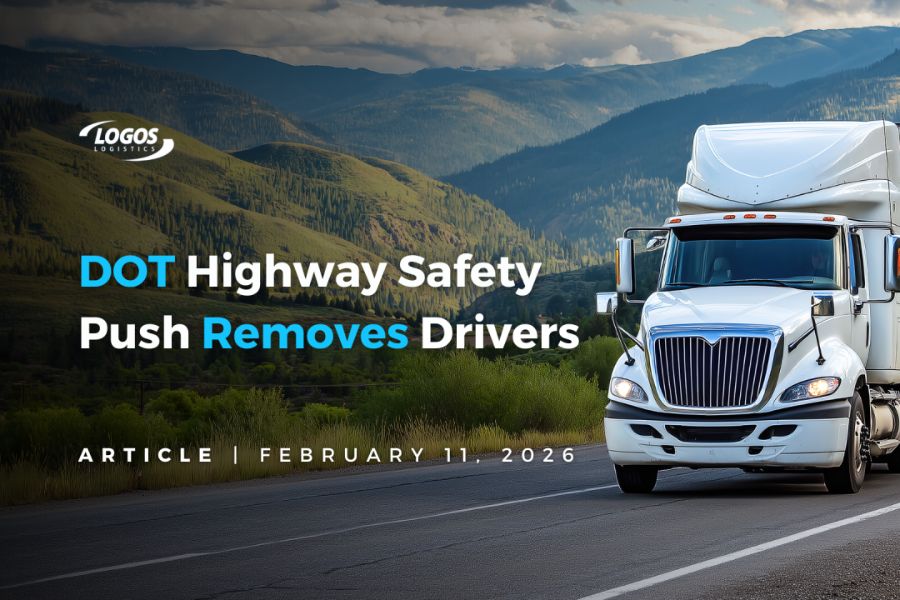
A January enforcement campaign led by the U.S. Department of Transportation resulted in nearly 2,000 commercial drivers and vehicles being taken out of service, according to federal officials.
The initiative, known as Operation SafeDRIVE, brought together the Federal Motor Carrier Safety Administration, state transportation departments in more than two dozen states, and law enforcement partners across the country. Transportation Secretary Sean Duffy commended the coordinated effort, describing it as a clear example of what can be achieved when federal and state authorities work jointly to remove unsafe and unqualified drivers from the nation’s highways.
Duffy emphasized that maintaining high safety standards requires a broad, government-wide commitment, adding that strong enforcement is essential to protecting families and reducing roadway crashes under the Trump administration’s approach to transportation safety.
FMCSA Administrator Derek Barrs characterized the three-day operation as fundamentally focused on public safety. He stressed that drivers who ignore regulations, lack proper qualifications, or operate vehicles while impaired pose serious risks to everyone on the road. Targeted enforcement efforts like Operation SafeDRIVE, he said, demonstrate the value of close partnerships and concentrated oversight in identifying and sidelining unsafe drivers and vehicles.
From Jan. 13–15, enforcement officers in 26 states and Washington, D.C., conducted 8,215 inspections. The effort led to 704 drivers being placed out of service for a range of violations and 1,231 vehicles being removed from operation. Authorities also reported 56 arrests tied to various charges.
The campaign was not limited to enforcement. FMCSA also used the initiative as an opportunity to reinforce safe driving practices among the motoring public. Officials reminded drivers to avoid lingering in truck and bus blind spots, to refrain from cutting off large vehicles, to never tailgate, and to pass safely. Motorists were advised to ensure they can see the truck or bus driver in the vehicle’s side mirror before attempting to pass, to signal clearly, and to confirm the larger vehicle is visible in their rearview mirror before merging back into the lane.
Federal officials reiterated that FMCSA’s core mission is to prevent crashes, fatalities, and injuries involving large trucks and buses. The agency establishes safety and regulatory standards for commercial driver’s licenses, analyzes safety data, sponsors research, and carries out enforcement and educational programs. It also routinely partners with nonprofit groups, state and local transportation agencies, and industry stakeholders to support driver training, inspections, and compliance efforts.
The American Trucking Associations endorsed the start-of-the-year campaign. Brenna Lyles, ATA’s vice president of safety policy, noted that safety regulations are only effective when consistently enforced. She credited federal leadership, state collaboration, and law enforcement officers for improving highway safety by removing potentially dangerous drivers and vehicles from service. Lyles also expressed the organization’s intent to continue working with Secretary Duffy, Administrator Barrs, and law enforcement agencies nationwide to ensure safety laws are applied fairly and consistently.
Operation SafeDRIVE, short for Distracted Reckless Impaired Visibility Enforcement, took place in Washington, D.C., and in Alabama, Arkansas, Connecticut, Delaware, Florida, Georgia, Illinois, Kentucky, Louisiana, Maine, Maryland, Massachusetts, Mississippi, New Hampshire, New Jersey, New Mexico, New York, North Carolina, Oklahoma, Pennsylvania, Rhode Island, South Carolina, Tennessee, Texas, Virginia and West Virginia.