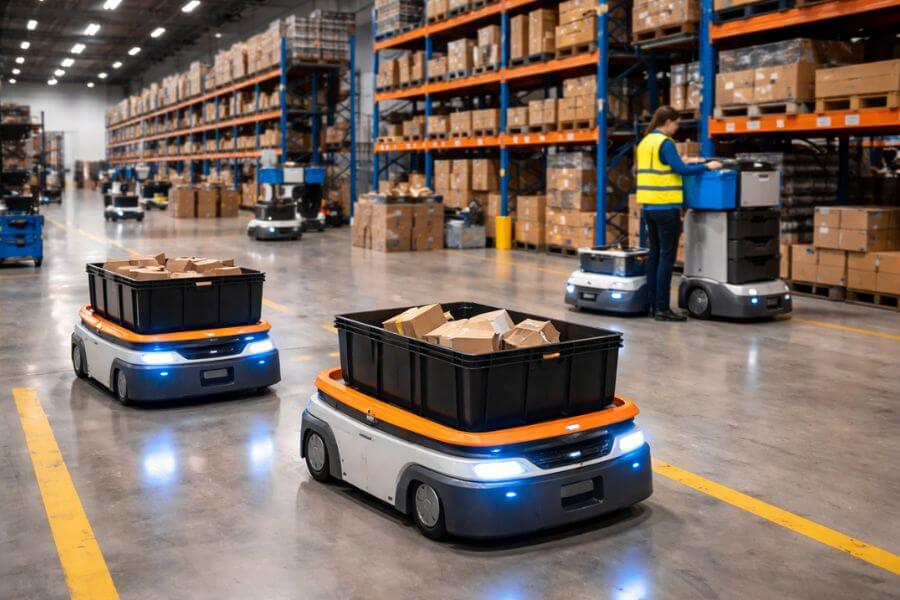
Robots-as-a-Service (RaaS) is quickly transforming how third-party logistics (3PL) warehouses operate. Instead of investing millions in automation hardware, warehouses can now subscribe to robotic systems on a monthly basis. This model allows companies to scale automation up or down depending on order volume and seasonal demand. For e-commerce fulfillment providers and logistics companies, RaaS delivers faster picking, improved accuracy, and lower labor dependency. Many modern 3PL facilities are adopting robotic fleets to handle repetitive warehouse tasks while humans focus on higher-value operations. In this article, we’ll explore the ten best RaaS platforms that are helping 3PL warehouses boost efficiency and productivity.
1. Locus Robotics
Locus Robotics is one of the most widely adopted Robots-as-a-Service platforms in the warehouse automation industry. Its autonomous mobile robots work collaboratively with human pickers to improve order fulfillment speed. Instead of employees walking long warehouse aisles, Locus robots guide them directly to picking locations, significantly reducing travel time. The system is particularly popular among e-commerce fulfillment providers and 3PL operators because it can be deployed quickly without major infrastructure changes. Locus operates on a subscription model that includes robots, software, maintenance, and analytics. Many warehouses report dramatic productivity improvements and faster order processing after implementing this platform.
2. Fetch Robotics
Fetch Robotics offers a flexible Robots-as-a-Service solution designed for logistics operations and warehouse environments. The platform specializes in autonomous mobile robots that transport inventory, pallets, and picking carts across large facilities. Fetch robots are equipped with advanced sensors and navigation systems that allow them to safely operate alongside human workers. The company focuses heavily on scalability, making it easy for warehouses to add more robots during peak seasons such as holidays or major e-commerce events. For 3PL companies managing multiple clients and fluctuating order volumes, this flexible automation model provides a powerful way to maintain operational efficiency.
3. Geek+ Robotics
Geek+ Robotics has become one of the fastest-growing warehouse robotics providers globally. Its Robots-as-a-Service platform focuses on goods-to-person picking systems, mobile sorting robots, and autonomous pallet movers. These robots dramatically reduce walking distance for warehouse workers by bringing products directly to picking stations. Geek+ solutions are widely used in e-commerce fulfillment centers, retail distribution hubs, and 3PL warehouses. One major advantage is the ability to integrate robotics with existing warehouse management systems without major facility redesign. With strong scalability and reliable performance, Geek+ helps logistics operators increase throughput while maintaining high order accuracy.
4. 6 River Systems
6 River Systems delivers a collaborative robotics platform that combines artificial intelligence with mobile warehouse robots. It’s a robot, commonly used in fulfillment centers, that assists warehouse associates with picking, packing, and inventory tasks. The Robots-as-a-Service model includes the robotic hardware, cloud-based software, and continuous system optimization. This platform is particularly well-suited for fast-growing e-commerce fulfillment operations that need quick deployment and reliable scalability. By guiding workers through optimized pick paths and verifying each item during the picking process, the system improves accuracy and speeds up order fulfillment for 3PL warehouses.
5. GreyOrange
GreyOrange provides advanced warehouse robotics solutions through a subscription-based Robots-as-a-Service platform. The company specializes in autonomous robots for goods-to-person picking, inventory movement, and intelligent warehouse orchestration. GreyOrange robots operate within an AI-driven system that continuously analyzes warehouse workflows to improve efficiency. This makes it particularly valuable for large 3PL warehouses managing complex fulfillment operations across multiple clients. The platform is designed to reduce labor-intensive processes while increasing order processing speed and accuracy. With flexible deployment options and scalable robotic fleets, GreyOrange enables warehouses to automate operations without massive upfront investment.
6. AutoStore
AutoStore is known for its high-density robotic storage and retrieval system that maximizes warehouse space utilization. Through a Robots-as-a-Service style deployment model offered by partners, warehouses can access robotic automation without purchasing the full infrastructure outright. AutoStore uses a grid-based storage system where robots retrieve bins from stacked inventory and deliver them to picking stations. This dramatically increases storage capacity and reduces warehouse footprint. Many e-commerce fulfillment providers and 3PL warehouses adopt AutoStore to handle high SKU volumes efficiently. The system allows operations to process orders faster while maintaining extremely accurate inventory control.
7. Exotec
Exotec has introduced a unique robotic solution that combines goods-to-person automation with vertical warehouse movement. Its robots can climb storage racks and retrieve inventory bins from multiple levels, maximizing warehouse storage capacity. Through flexible deployment models similar to Robots-as-a-Service, warehouses can adopt advanced automation without massive capital investments. Exotec systems are designed to integrate seamlessly with existing warehouse software platforms, making implementation faster and less disruptive. For 3PL operators dealing with fast-moving e-commerce products and limited warehouse space, Exotec offers a powerful combination of efficiency, speed, and storage optimization.
8. inVia Robotics
inVia Robotics focuses on e-commerce fulfillment automation through its scalable Robots-as-a-Service platform. The company deploys autonomous robots that navigate warehouse aisles and deliver products directly to human pickers. This approach significantly reduces walking distance while improving picking productivity. One advantage of inVia is its strong emphasis on data analytics and artificial intelligence. The platform continuously learns from warehouse activity and adjusts robot routes to improve efficiency. For 3PL warehouses that experience unpredictable order volumes, inVia offers flexible robotic fleets that can expand or shrink depending on operational needs.
9. HaiPick Systems
HaiPick Systems specializes in automated case handling robots that operate within high-density warehouse environments. Its robots move vertically and horizontally across storage racks to retrieve cases and deliver them to picking stations. Offered through a subscription-style automation model, the system allows warehouses to adopt robotics with reduced upfront investment. HaiPick solutions are particularly effective for facilities with large SKU counts and complex order profiles. By automating case retrieval and inventory transport, the platform helps 3PL warehouses increase picking speed while maintaining high accuracy and better inventory visibility.
10. OTTO Motors
OTTO Motors focuses on autonomous mobile robots designed for heavy material transport within warehouse and industrial environments. These robots can move pallets, carts, and large loads across long warehouse distances without human intervention. Through flexible service-based automation deployments, OTTO robots allow warehouses to automate internal transport tasks efficiently. This helps reduce labor costs and improve safety in facilities where manual pallet movement can be risky. Many logistics operations combine OTTO robots with other warehouse automation systems to create a fully optimized robotic workflow within modern 3PL fulfillment centers.
Conclusion
Robots-as-a-Service is rapidly becoming a practical solution for warehouses that want automation without massive capital investment. By subscribing to robotic systems instead of purchasing them outright, 3PL warehouses can scale automation based on demand while maintaining financial flexibility. Modern RaaS platforms offer autonomous robots, AI-driven optimization, and seamless integration with warehouse management systems. These technologies reduce manual labor, improve order accuracy, and accelerate fulfillment speed. As e-commerce continues to grow and logistics networks become more complex, RaaS will play an increasingly important role in helping warehouses stay competitive and efficient.
Frequently Asked Questions
What is Robots-as-a-Service in logistics?
Robots-as-a-Service is a subscription-based automation model where warehouses pay for robotic systems through monthly or usage-based fees. Instead of purchasing expensive hardware, companies access robots, software, maintenance, and analytics as a service. This allows warehouses to implement automation faster while reducing upfront investment and financial risk.
Why are 3PL warehouses adopting RaaS?
3PL warehouses face fluctuating order volumes and seasonal spikes. Robots-as-a-Service allows them to scale robotic fleets up or down depending on demand. This flexibility helps logistics providers maintain productivity, control labor costs, and handle peak e-commerce seasons without long-term infrastructure commitments.
How much does a RaaS platform cost?
The cost of Robots-as-a-Service varies depending on the number of robots, warehouse size, and automation features. Many providers charge a monthly subscription fee per robot, along with software access and maintenance services. This pricing model often makes automation accessible even for mid-sized warehouses.
Can RaaS integrate with warehouse management systems?
Yes, most modern RaaS platforms are designed to integrate with existing warehouse management systems. Integration allows robots to receive picking tasks, update inventory information, and optimize workflows automatically. This ensures robotics automation works seamlessly within current warehouse operations.
Do warehouse robots replace human workers?
Warehouse robots are typically designed to assist human workers rather than replace them. Robots handle repetitive and physically demanding tasks such as transport and item retrieval. Human workers focus on decision-making, quality control, and complex tasks that require flexibility and judgment.
How long does it take to deploy a RaaS system?
Deployment time varies depending on the platform and warehouse size. Many Robots-as-a-Service solutions can be implemented within weeks because they require minimal infrastructure changes. Autonomous mobile robots often operate using mapping technology instead of fixed conveyors or physical automation systems.
What warehouse tasks can robots automate?
Robots can automate many warehouse tasks, including order picking, goods transport, inventory retrieval, sorting, pallet movement, and storage optimization. These automated systems reduce manual travel distance, improve picking speed, and increase operational efficiency inside fulfillment centers.
Is RaaS suitable for small warehouses?
Yes, Robots-as-a-Service is often ideal for small and medium-sized warehouses because it eliminates the need for large upfront capital investment. Smaller facilities can adopt automation gradually by deploying a limited number of robots and expanding as order volume grows.
What industries benefit most from RaaS?
E-commerce fulfillment, retail distribution, third-party logistics, manufacturing logistics, and healthcare supply chains benefit greatly from Robots-as-a-Service. These industries typically handle large volumes of inventory and repetitive tasks that robotics automation can significantly improve.
Will RaaS become standard in warehouses?
Many logistics experts believe Robots-as-a-Service will become a standard warehouse automation model. As e-commerce demand grows and labor shortages increase, robotics platforms offer scalable and cost-effective solutions. The flexibility and lower financial risk make RaaS attractive for modern logistics operations.