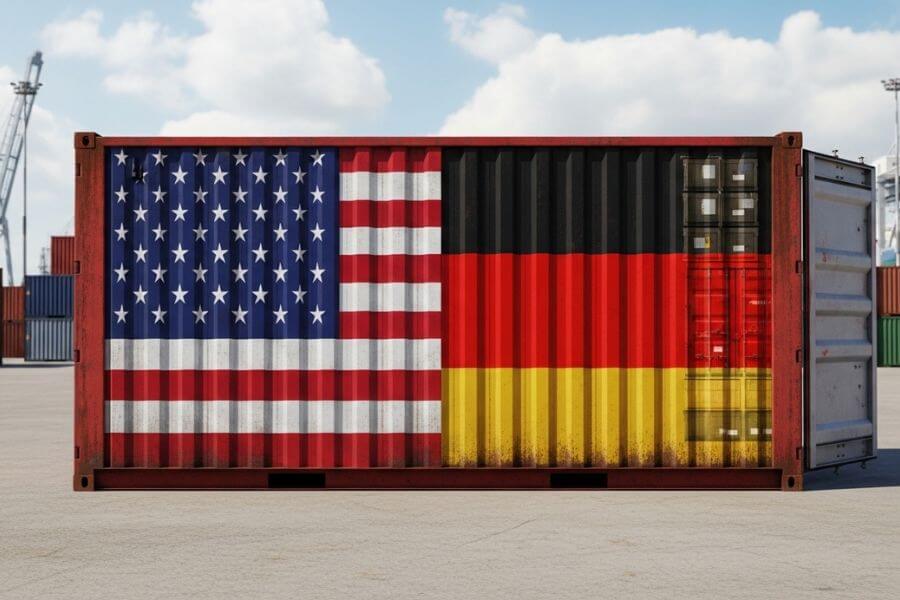
The transatlantic trade relationship between the United States and Germany is one of the most vital economic partnerships in the world. In 2024, the two countries traded nearly $330 billion in goods and services. Germany exported around $175.6 billion worth of goods to the U.S., making America one of its most important markets. Against this backdrop, it’s meaningful to explore exactly which goods dominate this cross‑Atlantic trade.
In this article, we’ll walk through the top 10 most traded goods between the U.S. and Germany, highlighting both what the U.S. imports from Germany and what it exports there.
1. Vehicles (Automobiles and Vehicle Parts)
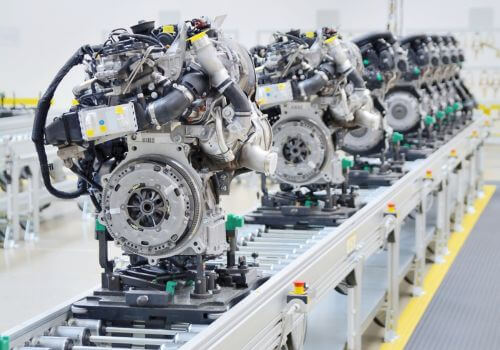
When it comes to U.S.-Germany trade, vehicles are arguably the most iconic category. Germany’s top exports to the United States include vehicles other than railway or tramway, and parts. In 2024, Germany exported approximately $36.8 billion in such vehicles to the U.S. These include passenger cars, high‑performance automobiles, and parts like transmissions, engines, and other automotive components.
This trade reflects Germany’s strength in its automotive industry, with globally recognized brands like BMW, Mercedes‑Benz, Volkswagen, and Audi playing a central role. The U.S. consumers’ persistent demand for German engineering contributes heavily to this sector’s prominence in bilateral trade.
On the flip side, the U.S. also exports vehicles to Germany. In 2024, U.S. exports of vehicles to Germany were around $9.19 billion. While not as dominant as Germany’s in sheer value, this two‑way vehicle trade underscores how deeply intertwined the automotive sectors of both countries are.
2. Machinery & Mechanical Appliances
Machinery is another cornerstone of U.S.-Germany goods trade. This includes a wide array of industrial machinery, mechanical appliances, and reactors. In 2024, Germany exported roughly $34.3 billion in machinery and mechanical appliances to the U.S. These goods represent Germany’s advanced manufacturing capabilities, everything from heavy machine tools to production-line robotics.
From the American side, machinery is also a significant export to Germany. The U.S. sent $7.57 billion worth of machinery, mechanical appliances, and reactors to Germany in 2024. These exports typically include high-tech manufacturing equipment, industrial devices, and specialized machinery used in sectors like chemicals, aerospace, and energy.
This mutual trade in machinery underlines the complementarity of the two economies: Germany’s demand for advanced equipment and the U.S.’ ability to supply high‑value industrial machinery.
3. Pharmaceutical Products
Pharmaceuticals rank among the top traded goods between the U.S. and Germany, which makes sense considering both countries’ strong life-science industries. Germany exported about $29.6 billion in pharmaceutical products to the U.S. in 2024. Many of these include finished medications, vaccines, and specialized therapeutic agents.
Meanwhile, the U.S. exported $7.67 billion in pharmaceutical products to Germany in the same year. This flow includes U.S.-made drugs, biotech treatments, and medical formulations that are in demand in the German healthcare system.
Given the high value, innovation intensity, and regulation in the pharmaceutical industry, this trade plays a critical role in the economic relationship and also in global health collaboration.
4. Aircraft, Spacecraft & Parts
Another heavyweight in the transatlantic exchange is aircraft, spacecraft, and their parts. The U.S. shipped $9.58 billion worth of aircraft, spacecraft, and parts to Germany in 2024. These exports include commercial aircraft components, jet engines, avionics, and other aerospace-related machinery.
Germany, in turn, exports its own aerospace products to the U.S., though with a more modest value (around $6.25 billion in 2024). These may be parts, systems, or specialized materials used in aviation and aerospace research.
This mutual aerospace trade underscores collaboration in high-tech sectors, as well as the strategic importance of aviation and defense technology in both economies.
5. Electrical Machinery, Equipment & Audio‑Video
Electrical machinery and equipment, including audio and video components, is another major traded category. In 2024, Germany exported $16.46 billion worth of electrical machinery to the U.S. These exports span a broad range, including power generators, transformers, circuit boards, and consumer electronics components.
From the U.S. side, electricity‑related machinery is also exported to Germany, with $6.18 billion in exports in 2024. These goods include sophisticated industrial electronics, communication devices, and electrical parts tailored for German manufacturing and infrastructure.
This category reveals how both economies depend on each other not just for heavy industrial machinery, but also for cutting-edge electrical and electronic components.
6. Optical, Medical, and Measuring Instruments
Optical, medical, and measuring instruments are critical goods in the U.S.-Germany trade relationship. These include microscopes, surgical instruments, diagnostic devices, measuring tools, and other precision equipment. Germany exports approximately $12.78 billion in these instruments to the U.S. in 2024.
On the U.S. side, exports to Germany in this category reached about $6.78 billion in 2024. Many of these are advanced medical devices, lab equipment, and high-precision instruments that feed both German research institutions and healthcare systems.
The trade in these high-value, technology-intensive products underscores the deep integration of the U.S. and Germany in scientific research, health care, and innovation.
7. Mineral Fuels, Oils & Bituminous Substances
One of the somewhat less glamorous but highly significant trade lines is mineral fuels, oils, waxes, bitumen, and related substances. In 2024, the U.S. exported about $6.56 billion of these energy-related goods to Germany.
Although Germany is a global industrial powerhouse, it still relies on energy imports, including specialized fuels and petroleum products. This trade helps fuel German manufacturing, transportation, and energy infrastructure.
8. Organic Chemicals
Organic chemicals represent another important traded good in the bilateral trade. Germany exported approximately $3.21 billion in organic chemical products to the U.S. in 2024. These might include specialized chemical intermediates, polymers, solvents, and other organic compounds used in manufacturing, pharmaceuticals, and industrial processes.
From the U.S. side, organic chemicals also flow into Germany; in 2024, U.S. exports in this category were $2.66 billion. This trade facilitates the high-tech chemical industry on both sides, including plastics, specialty chemicals, and precursors for drugs and materials.
9. Miscellaneous Chemical Products
In addition to organic chemicals, miscellaneous chemical products are also a major traded item. Germany exported about $3.28 billion worth of these in 2024. These chemicals can include detergents, dyes, industrial reagents, and other specialty chemicals.
Meanwhile, U.S. exports of miscellaneous chemical products to Germany in 2024 reached $2.18 billion. This exchange supports industries in both countries that rely on specialty chemicals for manufacturing, consumer goods, and research.
10. Articles of Iron or Steel / Base Metals
Rounding out the top 10 are iron, steel, and base metal products. Germany exported about $2.76 billion worth of articles of iron or steel to the U.S. in 2024. These include structural steel, sheets, rods, and other forms used in construction, machinery, and infrastructure.
While U.S.‑to‑Germany exports of base metals are smaller in comparison, historically, metals and metal products have been a critical part of bilateral trade, especially for industrial sectors.
Conclusion
The U.S.-Germany trade relationship is deeply rooted in the exchange of complex, high-value goods from cars and aircraft to pharmaceuticals and precision instruments. These top 10 traded products not only reflect the industrial strengths of both countries but also their strategic interdependence in innovation, infrastructure, and technology.
As both nations chart their economic futures, monitoring how these categories evolve will be critical. Will electric vehicles surge in place of traditional automobiles? Will green energy machinery dominate over mineral fuels? Or will entirely new categories, like AI-enabled industrial systems, emerge as trade leaders?
Understanding the composition of trade is more than just a numbers game; it’s a window into global economic transformation, bilateral strategy, and the future of manufacturing.