Warehouse automation in 2025 is defined by intelligence, flexibility, and data-driven decision-making. As logistics operators face ongoing labor shortages, rising e-commerce volumes, tighter delivery windows, and increasing cost pressure, automation is no longer optional; it’s a competitive necessity.
From AI-powered optimization engines to autonomous robots and cloud-native software, today’s warehouses are evolving into highly connected, predictive ecosystems. This in-depth guide explores the top 10 warehouse automation trends in 2025 and explains how they are reshaping efficiency, scalability, and customer experience across global supply chains.
1. AI-Driven Warehouse Intelligence
Artificial intelligence is becoming the central nervous system of modern warehouses in 2025. Rather than supporting isolated functions, AI now orchestrates end-to-end operations by analyzing large volumes of data from WMS platforms, robotics, IoT sensors, and historical order patterns.
These AI and machine learning systems optimize slotting, inventory placement, labor planning, and picking routes in real time. Warehouses are shifting from reactive operations to predictive ones, anticipating demand spikes, pre-positioning fast-moving SKUs, and dynamically reprioritizing tasks based on service-level agreements and carrier cutoff times. The result is shorter pick paths, fewer stockouts, higher order accuracy, and better decision-making through scenario simulations before changes go live.
2. Rapid Expansion of Autonomous Mobile Robots (AMRs)
Autonomous Mobile Robots are moving beyond pilot programs and becoming core infrastructure in warehouses worldwide. Unlike traditional conveyors or automated guided vehicles, AMRs navigate dynamically using onboard sensors, AI, and real-time mapping, allowing them to safely operate alongside people and adapt to congestion or layout changes.
In 2025, AMRs are widely used for goods-to-person picking, replenishment, returns processing, and zone-to-zone transport. New models support heavier payloads and modular attachments, while advanced fleet management software coordinates hundreds of robots simultaneously. This scalability makes AMRs a powerful solution for handling labor shortages, peak seasons, and fast-growing e-commerce operations.
3. Next-Generation AS/RS and High-Density Cube Storage
As warehouse space becomes more expensive and harder to secure, companies are increasingly building upward instead of outward. Automated Storage and Retrieval Systems (AS/RS) and cube-based storage solutions maximize vertical space by using shuttles, cranes, or grid-based robots to store and retrieve totes or cartons.
In 2025, modular AS/RS designs allow operators to scale capacity in phases while integrating seamlessly with AMRs and conveyor systems. For e-commerce and omnichannel fulfillment, cube storage enables high throughput, rapid order processing, and efficient management of thousands of SKUs within a compact footprint, reducing the need for additional facilities and improving delivery speed.
4. Collaborative Robots (Cobots) on the Warehouse Floor
Collaborative robots are becoming everyday tools in picking, packing, and palletizing operations. Designed to work safely alongside humans without full safety cages, cobots use advanced sensors and force-limiting technology to adapt their movements in real time.
In 2025, cobots commonly handle repetitive and physically demanding tasks such as case packing, labeling, kitting, and mixed-SKU pallet building. Their biggest advantage is flexibility: workers can quickly reprogram tasks using intuitive interfaces, enabling fast changeovers for new products, promotions, or seasonal demand without long downtime.
5. IoT-Enabled, Real-Time Warehouse Visibility
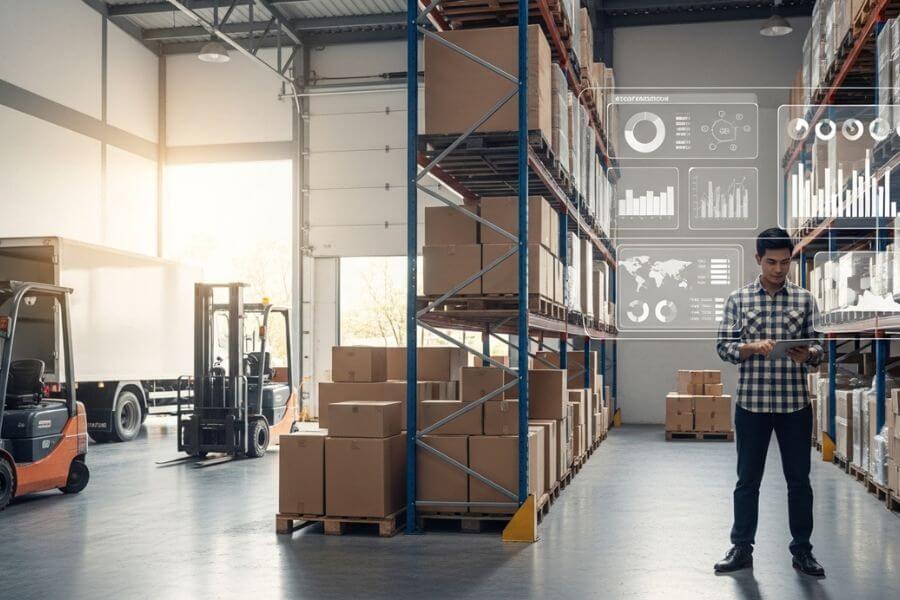
The Internet of Things (IoT) is transforming warehouses into fully connected, data-rich environments. Sensors embedded in pallets, forklifts, racks, and equipment provide continuous visibility into inventory location, asset movement, environmental conditions, and machine health.
In 2025, IoT-driven dashboards help managers identify bottlenecks, detect misrouted shipments, and respond to issues before they impact service levels. When combined with 5G and edge computing, IoT enables low-latency communication between robots and control systems supporting automated rerouting, congestion management, and predictive maintenance.
6. Digital Twins and Simulation-First Warehouse Design
Digital twins, virtual replicas of physical warehouses, are becoming essential tools for planning, testing, and optimization. By simulating layouts, workflows, automation equipment, and labor behavior, teams can evaluate new strategies without disrupting live operations.
In 2025, digital twins are increasingly connected to real-time WMS and IoT data, allowing operators to replay peak periods and test “what-if” scenarios such as demand surges or equipment failures. This approach reduces risk, improves ROI on automation investments, and supports continuous improvement in throughput, labor allocation, and service performance.
7. AR, VR, and Wearables for Workforce Augmentation
Augmented reality, virtual reality, and industrial wearables are becoming mainstream tools for warehouse productivity and training. AR smart glasses can display pick-by-vision instructions, bin locations, and packing guidelines directly in a worker’s field of view, reducing errors and onboarding time.
VR training environments allow new hires and temporary workers to practice tasks safely before entering live operations. At the same time, wearables such as ring scanners, voice-picking headsets, and ergonomic exoskeletons improve pick rates while reducing fatigue, supporting a human-centric approach to automation rather than full replacement.
8. Cloud-Native WMS and Connected Software Ecosystems
Warehouse Management Systems are rapidly shifting toward cloud-native, microservices-based architectures. In 2025, SaaS WMS platforms offer faster updates, built-in analytics, and standardized APIs that simplify integration with robotics, IoT, and AI solutions.
Cloud-based orchestration layers increasingly act as centralized control towers, dynamically assigning tasks to the most efficient mix of human workers, robots, and automation equipment. This flexibility allows warehouses to adapt quickly to new order profiles, customer requirements, and value-added services without complex system upgrades.
9. Sustainability-Driven Warehouse Automation
Sustainability is now a core consideration in warehouse automation strategies. In 2025, companies prioritize energy-efficient systems, waste reduction, and support for circular logistics processes such as returns, refurbishment, and resale.
Automation solutions increasingly feature smart power management, regenerative drives, and optimized equipment utilization to reduce energy consumption. High-density storage and intelligent cartonization help minimize packaging waste and transportation emissions, aligning warehouse operations with ESG goals and regulatory requirements.
10. Robotics-as-a-Service (RaaS) and Flexible Automation Models
The financial model for warehouse automation is evolving alongside the technology. Robotics-as-a-Service and subscription-based offerings allow companies to deploy automation without large upfront capital investments.
In 2025, this model is especially attractive to e-commerce brands, 3PLs, and fast-growing businesses that need flexible capacity. Vendors bundle hardware, software, maintenance, and remote monitoring into scalable service packages, often tied to performance-based SLAs, making automation more accessible and financially predictable.
Conclusion
Warehouse automation in 2025 is about building intelligent, flexible, and resilient operations that can adapt to labor challenges and rising e-commerce demand. AI, robotics, cloud-based systems, and data-driven tools are helping warehouses improve speed, accuracy, and scalability without sacrificing control.
By aligning automation investments with clear business goals and treating automation as an ongoing process, logistics operators can future-proof their warehouses, enhance customer experience, and stay competitive in an increasingly automated supply chain.