Transportation strategy isn’t as simple as just “moving freight from point A to point B.” It’s about protecting service levels, securing capacity, controlling costs, and building a supply chain that can adapt without breaking under pressure.
That is why more shippers are taking a closer look at dedicated transportation.
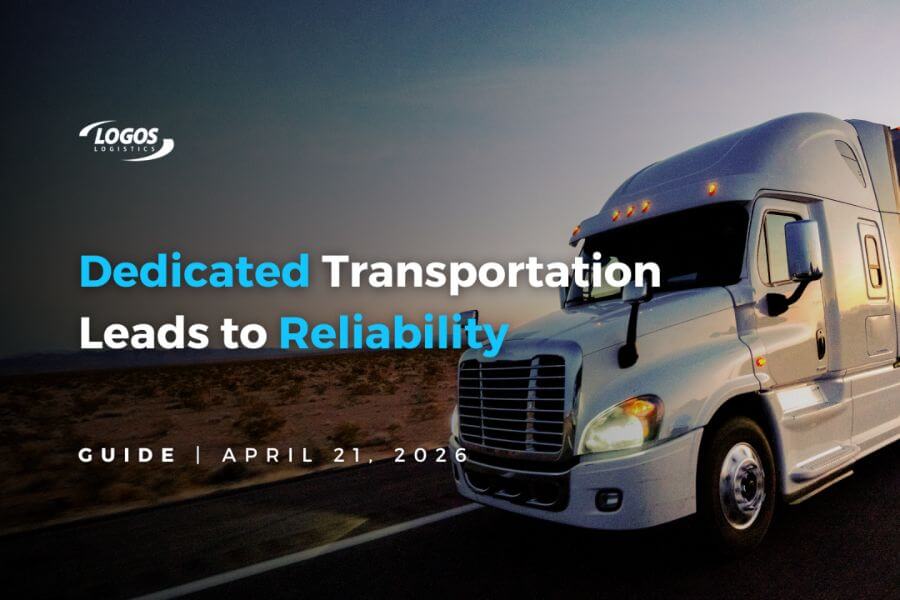
A dedicated transportation model gives a business reserved trucks, drivers, and routing support aligned to its operation instead of competing for shared market capacity load by load. Logos Logistics defines a dedicated carrier as a transportation provider that commits fleet and drivers to one client under a long-term agreement, creating exclusive capacity, customized routes, and consistent service.
For companies with repeat lanes, tight delivery windows, or service-sensitive freight, dedicated transportation is becoming less of a luxury and more of a strategic necessity.
Logos Logistics is especially well-positioned for this conversation because the company combines asset-based trucking with broader 3PL capabilities, including warehousing, order fulfillment, contract logistics, freight brokerage, and technology-enabled visibility. Its network spans Michigan, Ohio, Delaware, California, and an international presence in South Korea, giving customers access to both transportation capacity and integrated supply chain support.
What is dedicated transportation?
Dedicated transportation is a service model where a carrier assigns specific trucks, trailers, drivers, and operating resources to one shipper’s business. Instead of depending entirely on common-carrier or spot-market availability, the shipper gets reliable, reserved capacity built around recurring needs, lanes, schedules, and performance requirements.
In practical terms, it gives companies many of the benefits of a private fleet without forcing them to buy trucks, recruit drivers, manage maintenance, or absorb full compliance risk internally. Dedicated transportation is especially valuable when freight volumes are stable, routes are repetitive, and late deliveries create operational or financial consequences.
1. Guaranteed capacity matters more in 2026
One of the biggest reasons dedicated transportation is essential in 2026 is simple: capacity certainty has become a competitive advantage.
In a shared transportation environment, capacity can tighten quickly. Seasonal demand spikes, regional disruptions, lane imbalances, and changing customer demand can all make it harder to secure trucks when they are needed most. In a dedicated model, trucks and drivers are reserved for your business, which reduces exposure to those fluctuations and gives operations teams more confidence in daily execution. Logos’ glossary on dedicated carriers highlights guaranteed availability as one of the model’s core advantages, especially during peak periods when open-market capacity becomes scarce, and pricing becomes volatile.
For manufacturers, retailers, e-commerce brands, and just-in-time operations, this matters because transportation delays do not stay isolated. A missed pickup can become a production delay, a stockout, a failed customer commitment, or an expensive downstream expedite. Dedicated transportation helps prevent freight from becoming the weak link in the supply chain.
This is where an asset-based partner becomes even more valuable. Logos states that it provides asset-based trucking services across the U.S., supported by strategically located facilities and a growing fleet footprint. That combination gives shippers more control, more accountability, and a stronger foundation for consistent service than a purely transactional model.
2. Service consistency is now just as important as speed
In 2026, customers still care about speed, but consistency is often what protects margins and relationships.
Dedicated transportation improves consistency because the same drivers often run the same lanes and work with the same facilities. According to Logos’ definition, driver familiarity is a major feature of dedicated service: repeat drivers know the docks, site rules, appointment expectations, and unloading procedures, which helps reduce delays and operational errors.
That familiarity leads to real advantages:
- Fewer check-in issues at shipping and receiving points
- Better adherence to appointment windows
- Lower detention risk
- Faster loading and unloading
- More predictable transit performance
Over time, this kind of repeatability strengthens the entire operation. Warehouse teams know what to expect. Dispatch has clearer visibility. Customers receive more dependable ETAs. Internal planners can make decisions with more confidence.
This is particularly important in industries that cannot afford inconsistency. Logos already emphasizes its experience in sectors such as automotive, tires, batteries and electronics, consumer and retail, e-commerce, food and beverage, and industrial and aerospace. Those are all categories where missed deliveries, damaged timing, or inconsistent handling can ripple through production schedules and customer commitments.
Dedicated transportation is not just about reserving equipment. It is about building repeatable execution.
3. Predictable transportation costs help protect margins
Many businesses enter each year trying to reduce logistics spend, but the bigger issue is often cost volatility.
A dedicated transportation model can improve budgeting because pricing is typically contract-based rather than fully exposed to short-term market swings. Logos notes that dedicated carrier pricing is more predictable than common-carrier pricing, which is subject to changing supply-demand conditions.
That predictability gives finance, operations, and procurement teams several advantages in 2026:
First, it improves planning. When transportation costs are more stable, businesses can forecast landed costs more accurately and make cleaner decisions around inventory, replenishment, and customer pricing.
Second, it reduces surprise expenses. Companies relying heavily on the spot market are more exposed to rate spikes, surge pricing, emergency moves, and inefficient routing decisions when capacity disappears.
Third, it makes true cost analysis easier. A dedicated solution can be measured not only by linehaul rate, but by the broader operational savings it creates through better on-time performance, lower disruption costs, fewer expedites, reduced detention, and smoother warehouse coordination. Logos specifically points to operational efficiency gains such as faster load times, reduced detention, and long-term cost savings from repeat routes and familiar drivers.
Of course, dedicated transportation is not ideal for every shipper. Logos also notes that it is best suited to businesses with stable, higher-volume shipping needs rather than highly irregular freight profiles. But for the right operation, predictable transportation spend is not just financially helpful. It is strategically stabilizing.
4. Visibility and coordination are now non-negotiable
Transportation in 2026 is expected to be visible, trackable, and connected to the rest of the supply chain.
That is why dedicated transportation is most powerful when it is paired with technology and operational integration. Logos highlights both Warehouse Management System and Transportation Management System capabilities, including shipment scheduling, route scheduling, load configuration, GPS, web-based reporting, EDI connection, invoicing and reconciliation, and real-time reporting.
For shippers, this matters because freight decisions no longer happen in a vacuum. Transportation has to connect with:
- inventory status
- warehouse activity
- customer order timing
- outbound planning
- exception management
- performance reporting
A dedicated transportation arrangement creates a stronger environment for that coordination because the operating model is already structured around the customer’s lanes and requirements. Instead of constantly shifting between different carriers and communication styles, businesses can work inside a more unified process.
When a provider also offers warehousing and contract logistics, the benefit gets even stronger. Logos positions itself as a one-stop logistics solution, combining warehousing, trucking, fulfillment, and freight support under one umbrella. That matters in 2026 because many transportation problems are not really “truck problems.” They are handoff problems between storage, planning, order flow, and execution.
Dedicated transportation reduces those disconnects.
5. Dedicated transportation supports growth without the burden of a private fleet
As companies grow, they usually reach a point where shared transportation starts to feel too reactive, but building a private fleet still feels too expensive and operationally heavy.
That is where dedicated transportation becomes essential.
Logos’ dedicated carrier guidance makes the distinction clear: a dedicated model gives companies exclusive access to fleet resources without requiring them to own trucks, hire and manage drivers, handle maintenance, or take on the full burden of insurance and compliance. Compared with a private fleet, a dedicated carrier typically requires lower capital investment, offers predictable contract-based costs, and shifts much of the operational risk to the provider.
For growing businesses in 2026, this creates a practical middle path:
You gain control without taking on all the ownership risk.
You gain consistency without building an internal transportation department from scratch.
You gain scalability without waiting years to develop a private-fleet model.
That is especially attractive for mid-sized companies, multi-site shippers, and businesses entering new regions. Logos’ own network growth reflects that kind of scalable model. The company says it has expanded warehouse operations across multiple states, including newer and expanded facilities in Ohio, Delaware, and Michigan, while continuing to grow its asset footprint and nationwide service capability.
For a shipper trying to grow in 2026, dedicated transportation is not only about protecting today’s freight. It is about creating a transportation model that can grow with the business.
Why this matters for modern shippers
The case for dedicated transportation becomes even stronger when you look at how supply chains are operating today.
Businesses are balancing tighter delivery expectations, more customer visibility demands, leaner inventory strategies, and constant pressure to reduce disruption. In that environment, transportation cannot be treated as an interchangeable commodity. It needs to operate like a designed system.
Dedicated transportation helps create that system by delivering:
- reserved capacity
- repeatable execution
- better cost control
- stronger visibility
- scalable support for growth
That is why many companies in 2026 are moving away from purely transactional freight models for core lanes and core customers. They still use brokerage and flexible market capacity where it makes sense, but they anchor critical freight in a dedicated model.
For companies working in automotive, retail, industrial, aerospace, food, electronics, or e-commerce, that shift can make a measurable difference in service performance and resilience. Logos already serves many of those industries and pairs transportation with warehousing, fulfillment, and logistics technology, which makes its model particularly relevant for businesses looking for more than just truck capacity.
Why work with Logos Logistics?
If the goal is to make dedicated transportation work in the real world, the provider matters as much as the model.
Logos Logistics presents several strengths that align well with a dedicated strategy:
It is asset-based, which supports stronger control over transportation execution.
It offers integrated 3PL services, so transportation can be coordinated with warehousing, fulfillment, contract logistics, and freight brokerage.
It supports real-time visibility through WMS and TMS capabilities, including GPS and reporting tools.
It serves multiple high-demand industries where reliability and timing are critical.
It has expanded its network and operating footprint, including facilities in Michigan, Ohio, Delaware, California, and South Korea.
Together, those capabilities position Logos as more than a transportation vendor. They position it as a logistics partner that can help design and support a more resilient supply chain.
What’s next?
In 2026, dedicated transportation is essential because uncertainty is expensive.
When companies rely entirely on shared market capacity for critical freight, they expose themselves to service inconsistency, cost swings, and avoidable disruption. Dedicated transportation offers a better alternative for the right freight profile by creating stable capacity, consistent service, predictable costs, stronger visibility, and a scalable path to growth.
For businesses that want more control without building a private fleet, the dedicated model makes strategic sense.
And for businesses looking for a partner that combines asset-based trucking with warehousing, fulfillment, logistics technology, and multi-location infrastructure, Logos Logistics offers a strong foundation for that next step.