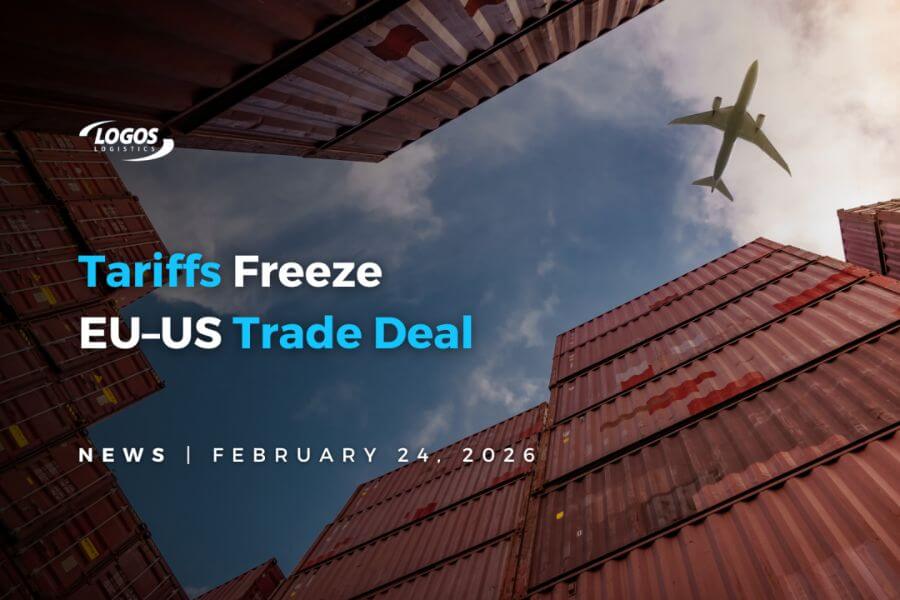
The European Union has slammed the brakes on ratifying its long-negotiated trade deal with the United States, and for the logistics world, that means another round of uncertainty rippling through global supply chains.
EU lawmakers on Feb. 23 froze legislative work on approving the agreement, choosing to wait until President Donald Trump clarifies his rapidly shifting tariff policy. The decision came just days after the U.S. Supreme Court struck down Trump’s use of emergency powers to impose sweeping “reciprocal tariffs” worldwide, throwing global trade rules back into question and leaving logistics planners scrambling to interpret what comes next.
Markets reacted quickly. European stocks and the S&P 500 both slipped 0.3% as investors, and by extension freight markets, weighed the implications of potentially higher duties and unstable trade lanes across the Atlantic.
For shipping lines, freight forwarders, and manufacturers that rely on predictable tariff regimes to plan everything from vessel capacity to warehouse inventory, the pause in ratification adds another layer of complexity. As European Parliament trade committee chair Bernd Lange put it at a Feb. 23 meeting, “We want to have clarity about the situation. We want to have clarity from the U.S. that they are respecting the deal because that’s a crucial element.” Without that clarity, logistics networks are left operating in a fog of shifting costs and potential reroutes.
A Deal in Limbo and Supply Chains Feel It
The EU-U.S. trade deal was reached last summer but has never been fully implemented, leaving companies on both sides of the Atlantic planning around a framework that may or may not materialize. If the agreement ultimately falls apart, it risks reopening trade tensions that would ripple across ports, trucking routes, rail corridors, and distribution hubs.
Tariffs shape logistics more than almost any other policy tool. Even a small percentage change can alter sourcing decisions, container volumes, and shipping routes. That’s why Trump’s rapid-fire tariff announcements are sending shockwaves through supply chain planning.
Within hours of the Supreme Court’s Feb. 20 ruling, Trump announced a new 10% global tariff, then quickly raised it to 15%. He also signaled that existing duties under Sections 301 and 232 would remain and ordered new Section 301 investigations on an accelerated timeline, probes that could lead to country-specific tariffs later on. For logistics managers trying to set quarterly freight contracts or secure warehouse space, the constant revisions make long-term planning nearly impossible.
Trump reinforced his stance on Feb. 23, warning on Truth Social, “Any Country that wants to ‘play games’ with the ridiculous Supreme Court decision, especially those that have ‘Ripped Off’ the U.S.A. for years, and even decades, will be met with a much higher Tariff, and worse, than that which they just recently agreed to. BUYER BEWARE!!!” For global shippers, that kind of language signals the potential for sudden cost spikes that can turn profitable trade lanes into loss-making ones overnight.
Why Logistics Companies Are Watching Closely
European officials now want firm answers before moving forward. The European Commission is actively seeking clarification from Washington on how new tariff plans intersect with existing agreements and whether previously negotiated terms will still apply.
The Group of Seven nations’ trade ministers also held a call Feb. 23, where EU Trade Commissioner Maros Sefcovic emphasized that “full respect” for the U.S. trade deal “is paramount.” Behind the scenes, EU ambassadors are holding additional discussions on how to manage the relationship — and the freight flows tied to it.
Tariffs, Metals, and the Mechanics of Trade
Under the deal’s initial terms, the EU agreed to accept a 15% tariff on most exports to the U.S. while removing tariffs on American industrial goods entering the bloc. The U.S., meanwhile, maintained a hefty 50% tariff on European steel and aluminum, a crucial detail for logistics because metals underpin industries from automotive to construction to heavy machinery.
The EU accepted the uneven terms largely to avoid a full-scale trade war and maintain U.S. security support, particularly regarding Ukraine. But the situation quickly grew more complicated when the U.S. expanded its 50% metals tariff to cover hundreds of additional products. That expansion disrupted procurement plans, altered shipping volumes, and forced manufacturers to reconsider where they source components and where they build finished goods.
For logistics providers, metals tariffs have an outsized impact: they influence bulk shipping demand, breakbulk cargo volumes, and even port infrastructure usage.
Political Tensions Meet Freight Reality
The trade deal’s rocky path hasn’t been shaped by tariffs alone. Broader political tensions, including Trump’s shifting stance on Ukraine and his controversial comments about Greenland, have repeatedly threatened to derail negotiations. At one point, the EU considered imposing tariffs on €93 billion ($110 billion) worth of U.S. goods, a move that would have triggered widespread supply chain disruption across multiple sectors.
Although that retaliation was shelved and ratification briefly resumed after Trump backed down on Greenland, lawmakers introduced new conditions, such as a sunset clause requiring further negotiations if the deal is approved. Each new amendment adds another variable for logistics planners already juggling volatile freight rates and geopolitical risk.
The Bottom Line for Logistics
For the logistics industry, the frozen ratification isn’t just political theater; it’s a real-time disruption risk. Tariff instability affects:
- Freight pricing and contract negotiations
- Shipping route selection and modal choices
- Inventory placement and warehouse demand
- Manufacturing sourcing decisions
- Port volumes and customs processing times
Until the U.S. and EU align on tariff policy, transatlantic logistics will remain in a holding pattern, with companies hedging bets, diversifying suppliers, and building extra flexibility into supply chains.
In global trade, predictability is currency. Right now, it’s in short supply, and the logistics sector is feeling every bit of the volatility.