The U.S. work week began under the lingering effects of a massive winter storm that continued to drop snow across the Northeast, following days of ice, power outages, impassable roads, grounded flights, and extreme cold across much of the southern and eastern United States.
Heavy snowfall blanketed a 1,300-mile corridor stretching from Arkansas to New England, with more than a foot reported in many areas by Jan. 26 and forecasts calling for as much as two feet in some of the hardest-hit regions. The accumulation brought highway traffic to a standstill, forced widespread school closures, and severely disrupted air travel, creating ripple effects across freight and supply chains nationwide.
Power infrastructure also took a major hit. More than 800,000 customers were without electricity Monday morning, primarily in the South, where sleet and freezing rain coated roads and downed trees and power lines. At the same time, more than 4,400 flights were delayed or canceled nationwide, adding further strain to time-sensitive cargo movements and intermodal operations.
Additional light to moderate snow lingered over New England through the evening, with towns like Falmouth, Massachusetts, effectively shut down as snow fell in dense sheets. Residents there were already digging out from seven inches, with more accumulation still expected, reinforcing a sense that daily life — and commerce — had been placed on pause.
In New York City, normally busy streets on Manhattan’s Upper East Side were transformed into temporary gathering spots for residents as the city slowed, a scene that underscored the broader shutdown rippling through transportation networks.
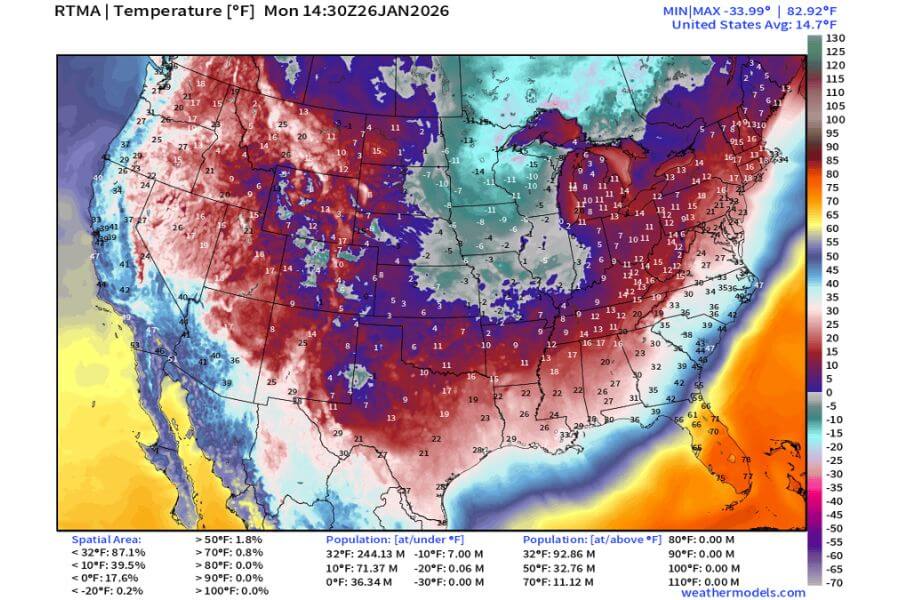
Behind the snow came dangerous cold. Temperatures plunged to minus 40 degrees Fahrenheit in parts of Minnesota on Jan. 25, and much of the Midwest, South and Northeast woke up to subzero readings the following morning. The average low temperature across the Lower 48 states was forecast to drop to minus 9.8 degrees Fahrenheit, the coldest national average since January 2014, with unusually warm conditions in Florida preventing the figure from falling even further.
Cold weather advisories and extreme cold warnings stretched from Montana to the Florida Panhandle as wind chills pushed conditions into life-threatening territory. Overnight refreezing turned previously treated roads back into sheets of ice early Jan. 26, compounding travel hazards just as freight carriers attempted to restart operations after the weekend storm.
State officials warned that improving precipitation conditions did not mean risks had passed. In Mississippi, freezing rain was cited as the primary danger, having slickened highways and brought down trees and power lines.
Major manufacturers, including Caterpillar, instructed employees at some facilities to remain home for multiple days, illustrating how industrial production and freight demand were directly affected. The state described the event as its worst ice storm since 1994, deploying a record 200,000 gallons of ice-melting chemicals along with salt and sand to keep key roadways passable.
At the storm’s peak, roughly 213 million people were under some form of winter weather warning. On Jan. 25 alone, about 12,000 flights were canceled and nearly 20,000 delayed, intensifying congestion at airports and distribution hubs and forcing trucking companies to reroute freight or hold loads until conditions improved.
For the U.S. trucking and logistics sector, the storm delivered a familiar but costly combination of highway closures, reduced driving speeds, equipment idle time, and missed delivery windows. Frozen diesel, mechanical failures caused by extreme cold, driver safety concerns, and inconsistent power availability at warehouses further complicated operations.
As highways reopened unevenly across regions, carriers faced backlogs at terminals and ports, while shippers braced for delayed inventories and spot market volatility driven by constrained capacity. The event once again highlighted how large-scale winter storms can quickly disrupt national supply chains, even when impacts are concentrated in specific regions.