In today’s fast-moving e-commerce landscape, speed and accuracy are everything. Customers expect same-day shipping, real-time tracking, and perfect orders. For warehouses handling high order volumes, traditional picking methods often fall short. That’s where cluster picking comes in.
Cluster picking is a warehouse order fulfillment strategy where pickers collect items for multiple orders at the same time during a single trip. By reducing travel time and eliminating post-pick sorting, this method significantly improves productivity, lowers labor costs, and increases fulfillment speed.
If you’re a logistics manager, e-commerce operator, or 3PL provider looking to optimize warehouse performance, here’s everything you need to know about cluster picking.
What is Cluster Picking?
Cluster picking groups similar customer orders into “clusters” based on SKU overlap, item location, or optimized pick paths. Instead of picking one order at a time, warehouse staff pick 4–8 orders simultaneously.
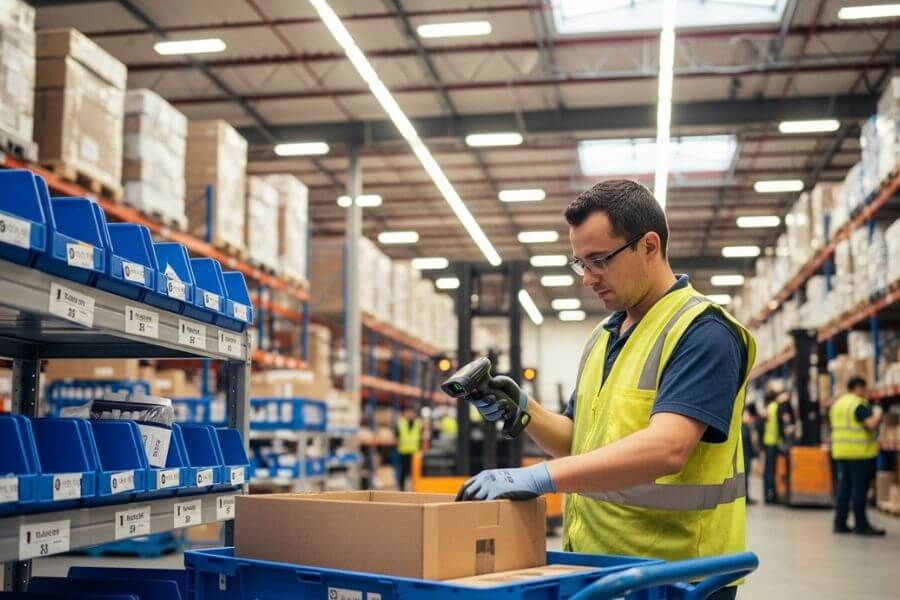
Pickers use specialized carts equipped with multiple bins, each bin assigned to a different order. As they move through the warehouse, they scan items and place them directly into the correct bin. This eliminates the need for sorting later.
A Warehouse Management System (WMS) powers the entire process by:
- Analyzing order data
- Grouping orders strategically
- Generating optimized pick routes
- Verifying accuracy in real time
Cluster picking is especially effective for e-commerce warehouses processing 100+ daily orders, where operational efficiency directly impacts profitability.
How Cluster Picking Works
The cluster picking process typically follows five key steps:
- Order Clustering: The WMS analyzes incoming orders and groups them by proximity, SKU similarities, or pick path efficiency.
- Route Optimization: Software calculates the shortest and most efficient path through the warehouse.
- Multi-Order Picking: Pickers move through the warehouse with multi-bin carts, collecting items for several orders in one pass.
- Real-Time Scanning: Using handheld scanners, voice-directed systems, or light-guided technology, pickers scan each item and place it into the correct bin instantly.
- Direct to Packing: Once complete, the cluster moves directly to packing, with no additional sorting required.
In optimized setups, this approach can reduce fulfillment time by up to 40%.
Equipment and Setup Requirements
To implement cluster picking effectively, you’ll need:
Multi-Bin Picking Carts
Typically designed with 6–12 bins, these carts allow pickers to separate orders during collection. Mobility and ergonomic design are critical for efficiency.
Optimized Warehouse Layout
Fast-moving SKUs should be placed in accessible, forward locations to shorten travel paths. Poor layout design can reduce efficiency gains by 20–30%.
Warehouse Management System (WMS)
Even a basic WMS can support clustering and route optimization. Advanced systems use AI-driven pathing that adapts to real-time inventory shifts.
Optional Enhancements
- Voice-directed picking systems
- Pick-to-light technology
- Conveyor integration
When implemented correctly, cluster picking can double the picks-per-hour compared to single-order picking.
Key Benefits of Cluster Picking
Cluster picking offers measurable operational improvements:
- Reduced Travel Time: Travel distance can decrease by 25–40%, since pickers handle multiple orders per trip instead of one.
- Higher Productivity: Pickers can achieve up to 2x the picks-per-hour compared to traditional single-order picking.
- Lower Labor Costs: More orders fulfilled per shift means reduced labor costs per order.
- Improved Accuracy: Since items are sorted during picking, error rates often drop below 0.5% in optimized systems.
- Faster Order Fulfillment: Ideal for same-day or next-day shipping models in e-commerce.
For high-volume warehouses, these benefits translate directly into higher throughput and improved customer satisfaction.
Cluster Picking vs. Other Picking Methods
Understanding how cluster picking compares to other warehouse picking strategies helps determine the right fit.
Single Order Picking
- One picker, one order per trip
- Best for low-volume or highly customized orders
- High travel time and lower throughput
Batch Picking
- Multiple orders picked together, unsorted
- Requires sorting after picking
- Good for orders with identical SKUs
Zone Picking
- Pickers stay within fixed warehouse zones
- Effective for very large facilities
- Requires handoffs between zones
Cluster Picking
- Multi-order picking with on-the-spot sorting
- Best for high-volume e-commerce
- Requires investment in carts and WMS
Cluster picking often works best when hybridized with zone picking in large distribution centers.
Best Practices for Successful Implementation
If you’re planning to adopt cluster picking, consider these proven strategies:
- Analyze historical order data to identify clustering opportunities
- Place high-velocity SKUs in forward pick zones
- Start with small clusters before scaling up
- Monitor KPIs like lines-per-hour (target: 50+)
- Maintain error rates below 0.5%
- Pilot in one zone before warehouse-wide rollout
Many logistics managers report improved throughput within the first 60–90 days of implementation.
Is Cluster Picking Right for Your Warehouse?
Cluster picking is ideal if:
- You process 100+ orders per day
- Orders contain multiple SKUs with overlap
- Travel time is a major bottleneck
- You aim to improve same-day shipping performance
If your operation averages 50+ lines per hour potential, cluster picking can significantly increase efficiency and scalability.
Why Cluster Picking Matters in Modern Logistics
As e-commerce continues to grow, warehouse efficiency becomes a competitive advantage. Cluster picking is one of the most effective order fulfillment strategies for high-volume operations seeking speed, accuracy, and cost control.
By reducing travel time, eliminating post-pick sorting, and maximizing labor productivity, cluster picking helps logistics teams meet rising customer expectations without proportionally increasing staffing costs.
For 3PL providers, e-commerce brands, and fulfillment centers aiming to scale, cluster picking isn’t just an optimization tactic; it’s a strategic advantage.