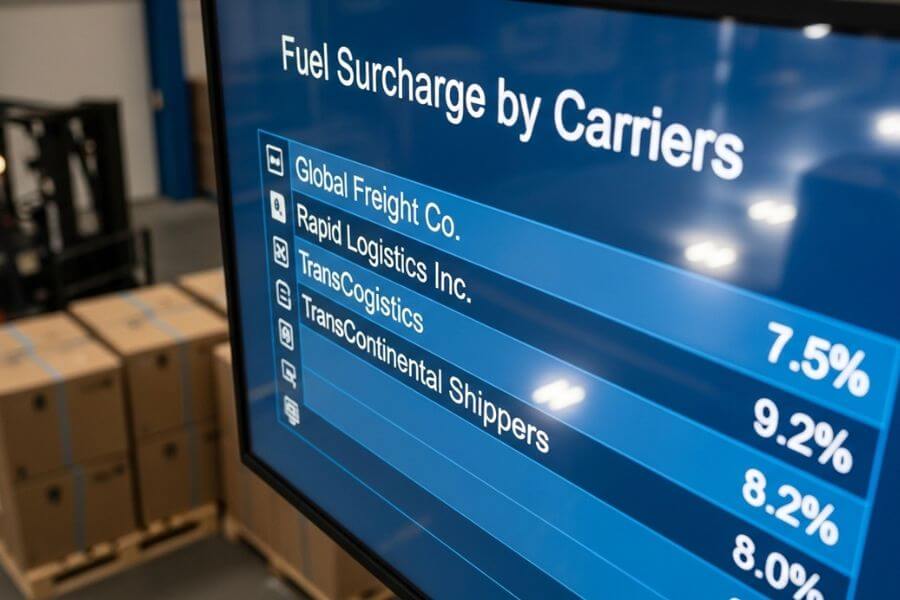
What Is a Fuel Surcharge?
A fuel surcharge is an additional fee charged by carriers: airlines, freight companies, couriers, or logistics providers on top of their base rate to offset the cost of fuel. Unlike standard fares or freight rates, which tend to be fixed for a contract period, fuel surcharges are dynamic: they rise when oil prices increase and drop when prices fall.
Think of it as a variable safety valve. Carriers lock in base rates months in advance, but fuel is one of their largest operating costs and can swing dramatically in a short period. Rather than repricing every shipment in real time, they apply a standardized fuel surcharge that adjusts periodically, typically weekly or monthly, based on a published fuel index.
Key Definition: A fuel surcharge is not a tax and not a profit margin; it is a cost-recovery mechanism that directly mirrors changes in fuel prices. That said, critics argue it can sometimes be used to pad margins.
A Brief History of the Fuel Surcharge
Fuel surcharges didn’t exist in mainstream shipping until the oil crisis of the 1970s. Before that, carriers absorbed fluctuating fuel costs as a normal business expense. But the OPEC embargo of 1973 caused crude oil prices to quadruple almost overnight, making that model untenable.
Airlines were among the first to formalize fuel surcharges, followed by ocean carriers and trucking companies. The practice became standard after the Gulf War spike of 1990–91, and again after crude prices surged past $100/barrel in the mid-2000s. Today, fuel surcharges are a permanent fixture across virtually every transportation sector.
“Fuel surcharges were born out of crisis and they’ve stayed because volatility never left.”Logistics Insider Editorial
Types of Fuel Surcharges
Not all fuel surcharges are created equal. The structure varies significantly by transportation mode and carrier policy.
1. Air Freight Fuel Surcharge (AFS)
Applied to international and domestic air cargo shipments. Usually expressed as a rate per kilogram (e.g., $0.65/kg). Airlines adjust these weekly or bi-weekly based on jet fuel prices and benchmark indices like the IATA Fuel Monitor.
2. Ocean Freight Fuel Surcharge (Bunker Adjustment Factor — BAF)
Shipping lines apply a Bunker Adjustment Factor (BAF), also called a Bunker Surcharge, to compensate for fluctuations in marine fuel (bunker fuel) costs. Since 2020, the International Maritime Organization’s (IMO) low-sulfur fuel regulations have added a separate Low Sulphur Surcharge (LSS).
3. Trucking / Road Freight Fuel Surcharge
Typically a percentage of the base freight charge or a flat per-mile fee. US trucking companies often reference the US Energy Information Administration (EIA) weekly diesel price index.
4. Airline Passenger Fuel Surcharge (YQ/YR)
Charged to airline passengers under fare basis codes YQ (fuel) and YR (carrier-imposed charges). These can range from $5 to over $200 per flight segment on long-haul international routes.
5. Courier & Express Delivery Fuel Surcharge
FedEx, UPS, and DHL publish weekly fuel surcharge tables for domestic and international packages. These are percentage-based and adjust weekly.
| Mode | Common Name | Typical Unit | Benchmark Index |
|---|---|---|---|
| Air Freight | AFS / FSC | $/kg or % of rate | IATA Fuel Monitor |
| Ocean Freight | BAF / Bunker | $/TEU or $/CBM | Singapore Bunker Prices |
| Road / Trucking | FSC | % of base or $/mile | EIA Weekly Diesel |
| Airline (Pax) | YQ / YR | $ per segment | Jet A1 spot price |
| Courier / Express | Fuel Surcharge | % of shipment value | EIA / Platts |
How Is Fuel Surcharge Calculated?
The calculation method varies by carrier and mode, but the general logic follows a sliding scale tied to a reference fuel price. Here’s how trucking companies in the United States typically do it:
Fuel Surcharge (%) = (Current Fuel Price − Base Fuel Price) ÷ MPG ÷ Base Rate × 100
Example: (5.00 − 1.25) ÷ 6.5 ÷ 1.50 × 100 ≈ 38.5%
For air freight, the formula is simpler: the surcharge per kilogram is published on a rate table that steps up or down based on where the average fuel price falls within a price band. For example:
| Jet A1 Price (USD/gallon) | AFS Rate (USD/kg) |
|---|---|
| Below $1.50 | $0.00 |
| $1.50 – $2.00 | $0.18 |
| $2.00 – $2.50 | $0.32 |
| $2.50 – $3.00 | $0.48 |
| $3.00 – $3.50 | $0.65 |
| Above $3.50 | $0.82+ |
Watch Out: Some carriers apply fuel surcharges to the chargeable weight, not the actual weight. If your shipment is voluminous but light, the dimensional (volumetric) weight formula will be used, meaning your surcharge is higher than you might expect.
Who Pays It and Who Profits?
In a supply chain, fuel surcharges are generally passed down the chain from the carrier to the freight forwarder or broker, to the importer/exporter, and ultimately to the end consumer in the price of goods.
- 20–30% of total air freight cost can be fuel surcharge
- 15–25% of ocean freight charges attributed to BAF
- 30–50% of a trucker’s operating costs is fuel
Critics point out that during periods of falling oil prices, carriers are slow to reduce surcharges, which creates a windfall. Conversely, when fuel prices spike unexpectedly, carriers argue surcharges still don’t fully cover their increased costs. The reality is that fuel surcharge transparency varies widely by carrier.
Fuel Surcharges by Industry
Airlines
Airline fuel surcharges (YQ) are among the most visible to consumers. They show up as a line item on your ticket, and on some routes, they exceed the base fare. Importantly, many frequent flyer redemptions are exempt from YQ surcharges depending on the airline and the program used; this is a key consideration for award ticket strategy.
Ocean Shipping
Container shipping lines use the BAF (Bunker Adjustment Factor) as a standard surcharge, but also introduce emergency fuel surcharges during price shocks. The IMO 2020 sulfur cap introduced the Low Sulphur Surcharge, which added hundreds of dollars per TEU on major trade lanes.
Trucking & LTL/FTL
In North American trucking, fuel surcharges are closely monitored by shippers. The EIA publishes retail diesel prices every Monday, and most carriers update their fuel surcharge tables weekly. LTL (less-than-truckload) shipments tend to see higher fuel surcharge percentages than FTL (full truckload).
Last-Mile & Courier Delivery
UPS, FedEx, and DHL update fuel surcharges weekly. For high-volume shippers, these percentage-based fees add up fast, especially during periods of elevated diesel prices.
Why Does the Fuel Surcharge Fluctuate?
Fuel surcharges move because crude oil and refined fuel prices are inherently volatile. Several forces drive this volatility:
- OPEC+ production decisions: Cartel-level decisions to cut or increase output directly affect crude prices globally.
- Geopolitical events: Wars, sanctions, and regional conflicts in oil-producing areas can cause sudden price spikes.
- Seasonal demand: Demand for diesel and jet fuel peaks at different times of year, affecting prices.
- Refinery capacity: Outages, storms, or planned maintenance can temporarily restrict the supply of refined fuels.
- Currency exchange rates: Oil is priced in US dollars; a weak dollar makes oil more expensive for carriers in other currencies.
- Economic growth and recession cycles: Broad economic activity drives energy demand, which feeds into fuel prices.
How to Reduce Fuel Surcharge Costs
While you can’t control oil markets, there are several practical strategies to minimize the impact of fuel surcharges on your shipping budget:
1. Negotiate a Fuel Surcharge Cap
When entering long-term shipping contracts, negotiate a maximum fuel surcharge percentage. Many large shippers secure caps that limit surcharge increases even if oil prices skyrocket.
2. Choose the Right Incoterms
Understanding who is responsible for freight costs under Incoterms (EXW, FOB, CIF, DDP, etc.) helps you decide whether it’s more cost-effective to control your own shipping arrangements.
3. Consolidate Shipments
Sending fewer, larger shipments reduces the number of surcharge events. LCL (less-than-container-load) consolidation, for example, can spread costs across multiple shippers.
4. Lock in Rates with All-In Pricing
Some carriers and freight forwarders offer all-in pricing that bundles the fuel surcharge into the base rate for a fixed period. This provides cost certainty, though you may pay a small premium for that predictability.
5. Monitor Weekly EIA and IATA Indices
Staying informed about fuel price movements lets you time shipments or renegotiate with carriers before a surcharge step-up kicks in.
6. Use a Transportation Management System (TMS)
A TMS can automatically benchmark carrier fuel surcharges against market rates, flag anomalies, and optimize routing to minimize overall freight costs.
Pro Tip: For airline passengers: booking award tickets through partner loyalty programs that don’t pass on YQ surcharges can save hundreds of dollars on long-haul business class redemptions.
Frequently Asked Questions
Is a fuel surcharge refundable if my shipment is cancelled?
It depends on the carrier’s policy. In most cases, if the shipment never moves, the fuel surcharge is refundable. However, some carriers treat it as a booking fee. Always check the terms and conditions of your carrier agreement.
Can I dispute an incorrect fuel surcharge?
Yes. If your carrier’s published surcharge table doesn’t match what you’ve been billed, you have grounds to dispute it. Keep records of invoice dates versus the applicable EIA or IATA index date that should apply.
Are fuel surcharges taxable?
In most jurisdictions, fuel surcharges are subject to the same taxes (VAT, GST, etc.) as the base freight charge. However, tax treatment varies by country, so consult your local tax advisor for specifics.
Why did my courier’s fuel surcharge go up when oil prices went down?
Carriers typically use a lagging index, meaning today’s surcharge reflects fuel prices from 2–4 weeks ago. There’s also a natural lag in adjusting rate tables downward. If prices remain low for a full quarter, you should see surcharges decline.
What is the difference between a fuel surcharge and an energy surcharge?
An energy surcharge is a broader term that can include electricity, natural gas, or other energy costs in addition to fuel. Some less-than-truckload (LTL) carriers use “energy surcharge” as an umbrella term. A fuel surcharge specifically targets road diesel or jet fuel costs.
Do fuel surcharges apply to customs duties or insurance?
No. Fuel surcharges are applied only to the freight or transportation portion of a shipment’s cost, not to duties, taxes, or insurance premiums.
Key Takeaways
Fuel surcharges are a fact of life in modern transportation, but they don’t have to be a mystery on your invoice. Understanding how they work puts you in a far stronger position when negotiating with carriers or managing your logistics budget.
- Fuel surcharges are cost-recovery fees, not taxes, tied to real fuel price indices.
- They vary by transport mode: AFS for air, BAF for ocean, FSC for road, and YQ/YR for passenger airlines.
- Calculation methods differ, but most are tied to a weekly or monthly government or industry fuel price benchmark.
- Fuel surcharges can represent 15–30% of total shipping costs, making them a major line item worth managing.
- Strategies like negotiating caps, consolidating shipments, and using all-in pricing can meaningfully reduce exposure.
- Stay informed: monitoring the EIA weekly diesel report and the IATA fuel monitor gives you advance notice of surcharge changes.