When staffing drivers, whether as a 3PL, a carrier, or part of a logistics network, it’s critical to understand the licensing status of your drivers. One increasingly discussed but complex area is the Non‑Domiciled Commercial Driver’s License (CDL). Non‑domiciled CDLs have become more common over the past several years. But recent regulatory changes are reshaping the landscape, making it essential for logistics providers, fleet managers, and brokers to stay informed.
In this article, we’ll explain what a non‑domiciled CDL is, who qualifies for it, why it matters, the recent rules changes, and what you should be doing now to stay compliant and manage risk.
What is a Non‑Domiciled CDL?
Under normal circumstances, a CDL, required to drive large commercial vehicles (tractor‑trailers, large buses, etc.), is issued by a U.S. state to a driver domiciled (i.e., permanently residing) in that state.
However, a non‑domiciled CDL is a special type of CDL issued to certain drivers who are not domiciled in the issuing state (or even in the U.S.). Under federal regulation, some states may issue a CDL or Commercial Learner’s Permit (CLP) to individuals domiciled in a foreign country, provided certain conditions are met.
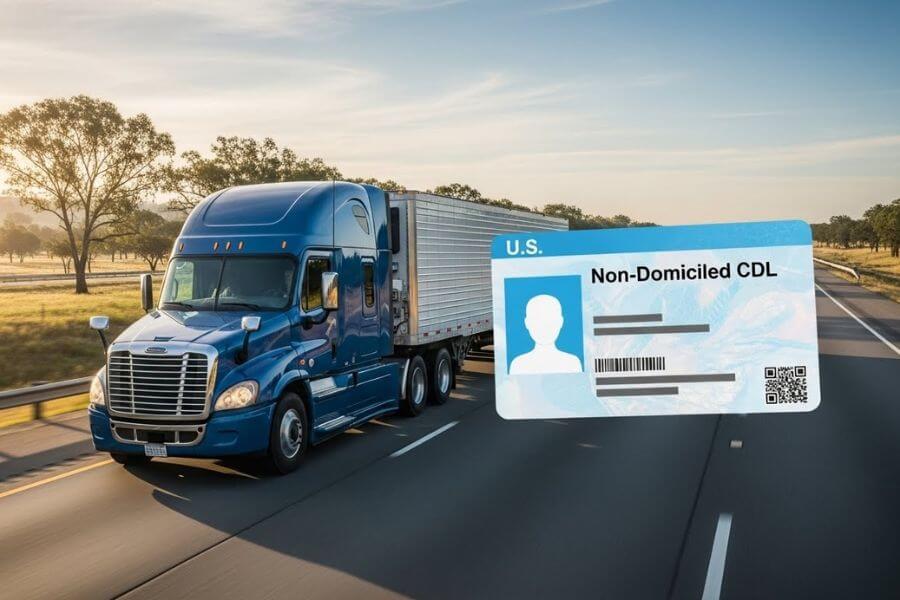
When issued, the license explicitly includes the marking “Non‑domiciled” to distinguish it from a standard CDL.
In short, a non‑domiciled CDL allows legally authorized non‑U.S. residents (or non‑permanent residents) to operate U.S. commercial motor vehicles under regulated conditions.
Who is Eligible for a Non‑Domiciled CDL?
Eligibility rules vary by state, but federal regulation outlines the broad framework.
Here’s who typically qualifies:
- Foreign nationals lawfully present in the U.S., but without U.S. permanent residency or citizenship. Often, they hold valid immigration status (e.g., certain work visas) and appropriate documentation such as a valid passport + approved I‑94, or other approved proof of lawful presence/authorization to work.
- People domiciled in a foreign country (excluding Canada or Mexico), because Canada and Mexico are excluded due to separate licensing agreements.
- In certain states, individuals from U.S. states that are prohibited from issuing CDLs (if that state is out of compliance) may also qualify to obtain a non‑domiciled CDL from another state that still issues them.
To qualify, applicants must pass the same CDL knowledge and skills tests, meet medical standards, and satisfy all other requirements stipulated under federal regulation (e.g., age, English proficiency, lawful presence, documentation) that apply to standard CDLs.
In many states, non‑U.S. citizens must verify their lawful status each time they apply for or renew a CDL/CLP (for example, via the federal SAVE system).
Why Non‑Domiciled CDLs Have Grown and Why They Matter to 3PLs
The Growing Number of Non‑Domiciled CDLs
Recent public reporting indicates non‑domiciled CDLs are no longer niche: more than 60,000 non‑domiciled CDLs have been issued across the U.S. states that provided data.
Some states saw rapid growth in issue rates, especially among drivers using temporary or work‑visa-based authorizations. This trend has captured the attention of regulators and industry stakeholders alike, because it affects driver supply, compliance burden, liability, and overall safety.
Importance for 3PLs, Carriers, and Brokers
For a 3PL business, knowing a driver holds a non‑domiciled CDL is not just a legal or regulatory question; it’s a business risk and operational consideration. Why:
- Compliance risk: Non‑domiciled CDLs are subject to heightened regulatory scrutiny. If the license is improperly issued or later invalidated, a 3PL using that driver could face liability or disruptions.
- Workforce flexibility: During driver shortages, non‑domiciled CDLs have been a source of qualified labor. For 3PLs depending on capacity, this has been a way to keep supply chains moving.
- Uncertainty and volatility: Because of changing rules, non‑domiciled CDLs may become less reliable over time. Fluctuations in legality may disrupt long‑term planning, contracts, and driver availability.
- Reputation and safety exposure: Regulators have cited safety concerns where non‑domiciled CDLs were improperly issued, triggering crashes.
Given these realities, any 3PL considering the use of non‑domiciled CDL holders must weigh operational advantage against evolving regulatory and compliance risks.
The 2025 Regulatory Shake‑Up: What’s Changing and What That Means
In September 2025, the Federal Motor Carrier Safety Administration (FMCSA) triggered a major regulatory shift with an emergency action — Interim Final Rule: Restoring Integrity to the Issuance of Non‑Domiciled CDLs.
Key changes under the new rule:
- The rule significantly restricts which non‑U.S. residents are eligible for non‑domiciled CDLs. Specifically, only certain visa types (for example, H‑2A, H‑2B, E-2 under some state guidelines) may now qualify, stricter than prior broader eligibility.
- Many states have responded by halting issuance of non‑domiciled CDLs and CLPs altogether. For example, the state agency in Oregon announced on September 29, 2025 that it stopped issuing them.
- For holders of existing non‑domiciled CDLs, there may be renewed scrutiny, potential revocation, non-renewal, or conversion/downgrade to a standard (non‑CDL) license.
- The federal rule aims to restore “integrity” to issuance processes, after audits found a number of improperly issued licenses.
Implications for the industry (and for 3PLs):
- According to one industry report, nearly 200,000 non‑domiciled CDL / CLP holders could be affected.
- As states pause issuance or renewals, driver supply from non‑domiciled holders may shrink. That could tighten capacity with ripple effects on freight rates, driver shortage pressure, and reliability of contracted capacity.
- For fleets or carriers that rely heavily on non‑domiciled drivers, there is a risk of license expirations, cancellations, or non-renewals, which could disrupt operations if not tracked carefully.
It’s important to note: as of a recent update, a court has issued a stay on enforcement of parts of the new rule, pending further review. That means, for now, non-domiciled CDLs may continue to be issued/renewed under earlier rule sets, but the regulatory environment remains uncertain and could change depending on the court’s decision or further FMCSA action.
What 3PLs and Logistics Companies Should Do: Risk Management & Best Practices
Given current uncertainty around non‑domiciled CDLs, here are recommended best practices for 3PLs, carriers, and freight brokers to manage compliance, minimize risk, and make informed decisions:
- Audit your driver roster: Review your drivers to identify those with non‑domiciled CDLs. Keep documentation (copy of CDL, visa status, I‑94 or other immigration/work‑authorization proof) on file.
- Verify licensing validity proactively: Because renewals and eligibility are shifting, periodically check with the issuing state’s DMV/DMV equivalent to confirm each non‑domiciled CDL is still valid and in compliance.
- Plan for contingencies: Given the potential reduction in non‑domiciled CDL issuances and renewals, build contingency plans (e.g., recruiting U.S.-domiciled drivers, diversifying driver sources) to avoid capacity shortfalls.
- Stay updated on regulation & court rulings: Since the regulatory environment remains unsettled (with stays and possible future changes), assign a compliance lead to monitor developments from FMCSA, state DMVs, and federal court decisions.
- Scrutinize hiring and onboarding paperwork: If hiring foreign nationals or non‑permanent residents as drivers, ensure they meet whatever immigration/visa documentation is currently acceptable under state-specific rules (and note that that may change).
- Communicate with clients transparently: If you rely on non-domiciled drivers for capacity, inform clients about potential regulatory risks that could affect capacity or continuity.
Potential Impact on Freight Capacity, Costs & 3PL Strategy
Because non‑domiciled CDLs have supplied a significant share of commercial drivers in recent years, any large‑scale reduction in their issuance or renewal could materially impact freight capacity across the country, which in turn affects supply chains, freight rates, and 3PL operations.
- Tightening driver supply could lead to higher rates for carriers and shippers alike, as demand outpaces available licensed drivers.
- Shifts in capacity sources: Carriers may need to recruit more U.S.-domiciled drivers, or shift to different regions/states with more available licensed drivers.
- Greater scrutiny on compliance and documentation: Especially for cross‑border freight, seasonal work, or operations with foreign‑authorized drivers.
- Need for agility in 3PL planning: 3PL providers may need to diversify carrier partnerships, consider contract clauses for contingencies, and proactively manage capacity risk.
If your company often brokers loads, arranges carriers, or relies on contracted fleets, this could be a strategic inflection point where what was once a source of low-cost capacity may become a constraint.
Key Takeaways
- A non‑domiciled CDL allows legally authorized non‑U.S. residents (or non‑permanent residents) to operate commercial vehicles in the U.S., under special licensing rules.
- Eligibility requires lawful presence, acceptable visa/immigration status, compliance with the same testing and medical standards as standard CDLs, and license marking “Non‑domiciled.”
- There are now over 60,000 non‑domiciled CDLs issued nationwide (in states that provided data), making this a significant driver pool for the trucking/logistics industry.
- But the regulatory environment is changing; a 2025 interim final rule from the U.S. Department of Transportation and FMCSA has tightened eligibility, restricted issuance/renewal, and raised compliance demands.
- For 3PLs and carriers, that translates to increased risk: licensing validity may be unstable, driver supply could shrink, and capacity planning must adapt accordingly.
- The prudent approach: audit all driver documentation, stay on top of rule changes, plan contingencies, and communicate transparently with clients and partners.
Conclusion
The concept of a non‑domiciled CDL has allowed a broader pool of drivers, including non‑U.S. residents, to support American freight and logistics operations. For many years, this provided a valuable channel to meet driver demand. However, with recent regulatory shifts and heightened scrutiny, the role of non‑domiciled CDLs is increasingly precarious.
For 3PL companies, carriers, and brokers, this is not just a licensing issue; it’s a strategic business issue. The next 12 to 24 months may bring major changes to driver supply, compliance obligations, and capacity management.
If your company depends (or might depend) on non‑domiciled CDL‑holding drivers, it is recommended to conduct an immediate internal audit, update compliance policies, and build in flexibility now.
Non-Domiciled CDL FAQs
1. What does “non‑domiciled” mean on a CDL?
A non‑domiciled CDL is issued to a driver who does not permanently reside in the issuing U.S. state or is not a U.S. citizen or permanent resident. It allows certain foreign nationals to legally drive commercial vehicles in the U.S. under federal and state regulations.
2. Who is eligible for a non‑domiciled CDL?
Eligibility usually includes lawfully present foreign nationals with valid work visas or other approved immigration status. Applicants must meet age, medical, and testing requirements, just like standard CDL holders.
3. Can non‑domiciled CDL holders work for any U.S. trucking company?
Yes, as long as they are legally authorized to work in the U.S. and hold a valid non‑domiciled CDL. Companies should always verify license validity and documentation before hiring.
4. Are non‑domiciled CDLs affected by recent regulatory changes?
Yes. The 2025 FMCSA interim rule tightened eligibility requirements, restricted issuance in many states, and increased compliance scrutiny. Driver supply from non‑domiciled CDLs may shrink, making monitoring essential.
5. How can 3PLs ensure compliance with non‑domiciled CDL regulations?
3PLs should audit all drivers’ licenses and documentation, stay updated on state and federal rules, and plan contingencies in case drivers lose eligibility. Maintaining proper records and proactive compliance is key to avoiding legal and operational risks.