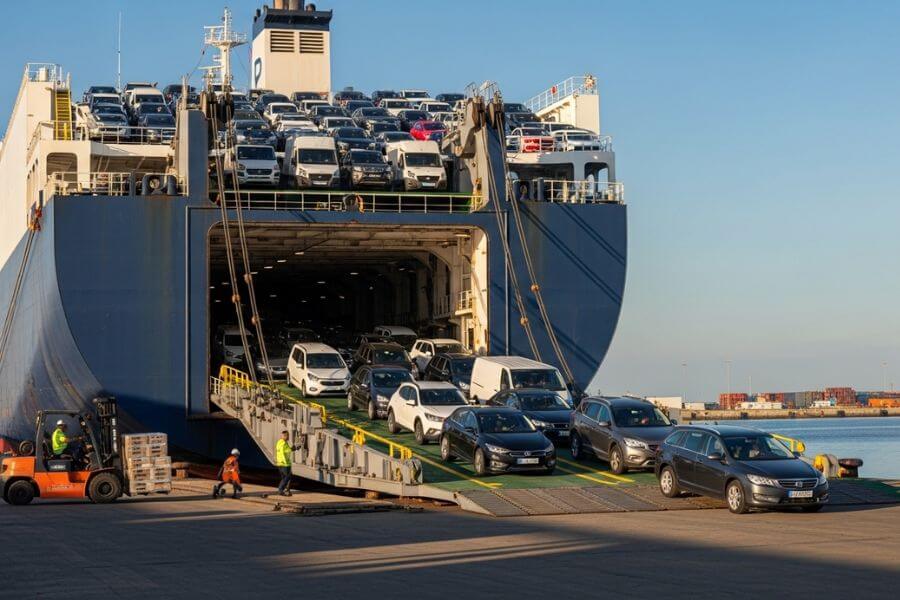
What Is Roll-On/Roll-Off (RoRo) Shipping?
Roll-On/Roll-Off (RoRo) is a method of ocean freight transportation designed specifically for wheeled cargo, vehicles and machinery that can be driven or towed directly on and off a ship. The name describes the process perfectly: cargo rolls on at the port of origin and rolls off at the destination port.
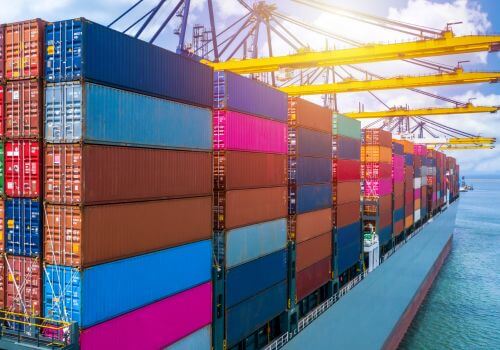
Unlike conventional container shipping, where goods are loaded into steel boxes using cranes, RoRo ships are equipped with built-in ramps and multiple decks that allow wheeled vehicles and rolling stock to be driven aboard under their own power or with the help of tugmaster vehicles.
“RoRo is the maritime equivalent of a multi-story car park that floats across oceans, purpose-built, efficient, and indispensable to global trade.”
The concept was first developed in the 1950s to transport military vehicles, but it quickly evolved into one of the most important segments of international shipping, handling hundreds of millions of vehicles and pieces of heavy equipment every year.
How Does RoRo Shipping Work?
The RoRo process is deceptively simple, yet it involves precise logistics and coordination between shippers, port operators, and ocean carriers.
Step 1: Cargo Delivery to Port
The shipper (or an authorized agent) drives or transports the wheeled cargo, such as a car, truck, tractor, or construction machine to the designated RoRo terminal. Vehicles must be in running condition for self-propulsion whenever possible; non-running units require special handling and may incur additional fees.
Step 2: Pre-Loading Inspection & Documentation
Before any vehicle boards, it undergoes a thorough condition survey. Existing damage is documented with photos and noted on a Vehicle Condition Report (VCR). This step is critical for insurance and liability purposes. Shipping documents like Bill of Lading, commercial invoice, and title/registration are also processed at this stage.
Step 3: Rolling On (Loading)
Vehicles are driven up the ship’s stern ramp or quarter ramp by professional drivers (called “jockeys” or vehicle handlers). They are then carefully positioned on the appropriate deck and secured with lashing chains, straps, or wheel chocks to prevent movement during the voyage. Deck officers oversee weight distribution to maintain the ship’s stability and trim.
Did You Know: A single large RoRo vessel can carry up to 8,000 car equivalent units (CEUs), enough to transport the monthly output of a major car manufacturing plant in one voyage.
Step 4: Ocean Transit
The ship departs on its scheduled route. During transit, the ship crew regularly inspects the cargo decks to check lashings and ensure no fuel leaks or other hazards develop. Vehicles are stored in enclosed, ventilated decks protected from sea spray and weather.
Step 5: Rolling Off (Discharge)
Upon arrival, vehicles are systematically driven off the ship via ramps in reverse loading order. Another condition survey is performed at discharge. The consignee or their customs broker collects the cargo after completing port formalities and paying any applicable duties.
Types of RoRo Vessels
Not all RoRo ships are alike. The industry has developed several specialized vessel types to serve different cargo profiles and trade routes.
- Pure Car Carrier (PCC): Designed exclusively for automobiles. Multiple light-duty decks optimized for maximum car density. Iconic tall, boxy silhouette seen in major auto-exporting ports like Yokohama and Bremerhaven.
- Pure Car & Truck Carrier (PCTC): The most common modern type. Higher, adjustable decks accommodate both passenger vehicles and commercial trucks, buses, and agricultural equipment. More flexible than PCCs.
- ConRo (Container-RoRo): Hybrid vessels with below-deck RoRo capacity and above-deck container stowage. Ideal for mixed cargo trades where both rolling stock and containerized freight need to move together.
- RoRo Ferry: Shorter-distance vessels serving fixed routes, often carrying passengers alongside freight. The English Channel ferries and Baltic Sea routes are classic examples of high-frequency RoRo ferry operations.
- Heavy Lift RoRo: Reinforced vessels built for exceptionally heavy rolling cargo like mining equipment, power plant components, military vehicles, and oversized industrial machinery weighing hundreds of tonnes.
- RoPax (RoRo + Passenger): Combines vehicle cargo decks with passenger accommodation. Common in Mediterranean, Scandinavian, and island routes where both freight and travelers need carriage on the same service.
What Cargo Can RoRo Carry?
The term “RoRo cargo” covers an enormous range of wheeled or tracked goods. Anything that can roll, drive, or be made to roll qualifies:
- Passenger Vehicles: Cars, SUVs, minivans, and motorcycles. The backbone of the global automotive export trade, Japan, Germany, South Korea, and the US, all rely heavily on RoRo for new vehicle exports.
- Commercial Vehicles: Trucks, buses, coaches, ambulances, and fire engines. These require higher deck clearance, a key advantage of modern PCTCs over older pure car carriers.
- Agricultural Machinery: Tractors, combines, harvesters, and farm implements. High-value, large-format equipment that is difficult to containerize and perfectly suited to RoRo.
- Construction Equipment: Excavators, bulldozers, cranes, and road rollers. Often tracked rather than wheeled, these can be towed aboard on trailers or driven using temporary wheel sets.
- Industrial Equipment: Generators, transformers, turbines, and processing modules. When too large for containers, these are mounted on self-propelled modular trailers (SPMTs) for RoRo loading.
- Military Equipment: Tanks, armored personnel carriers, military trucks, and aircraft. Defense logistics agencies worldwide use dedicated RoRo charter services for troop and equipment deployment.
Advantages of RoRo Shipping
RoRo has remained a dominant shipping method for wheeled cargo for decades because its core advantages are genuinely compelling:
Speed & Efficiency of Loading/Discharge
Vehicles drive on and off under their own power or with a tug; this is dramatically faster than crane operations required for heavy containers. A RoRo terminal can turn around a large vessel in 24–48 hours, reducing port time and improving vessel utilization.
Lower Risk of Cargo Damage
Vehicles are not lifted, suspended, or craned. The absence of lifting eliminates one of the most common causes of freight damage. Properly lashed vehicles simply ride the waves in a stable, enclosed environment.
No Special Packaging Required
Cars and machinery are shipped essentially as-is. There is no need to crate, containerize, or specially package wheeled vehicles, which significantly reduces preparation costs and turnaround time at origin.
Cost-Effective for Vehicles at Scale
For large volumes of new vehicles, RoRo is consistently more economical than container shipping. The per-unit cost of shipping a car via RoRo is lower because ships are purpose-built for density, with no wasted space inside containers.
Flexibility for Oversized & High-Value Cargo
Items that simply cannot fit in a standard 20ft or 40ft container, such as large agricultural machines, mining trucks, yachts, and industrial equipment, can be accommodated on RoRo vessels, often at a lower cost than breakbulk alternatives.
Global Network & Regular Sailings
Major RoRo operators such as Höegh Autoliners, Wallenius Wilhelmsen, and NYK Line offer extensive global schedules with regular fixed sailings, giving shippers reliable transit time commitments.
Disadvantages & Limitations of RoRo
RoRo is not a universal solution. There are meaningful trade-offs to consider:
Limited to Wheeled or Rollable Cargo
By definition, RoRo only works for cargo that can roll. General merchandise, palletized goods, bulk commodities, and fragile freight that cannot be driven or towed are simply incompatible with the RoRo model.
Weather & Security Exposure
Although modern vessels have enclosed decks, the loading and discharge process exposes vehicles to the open port environment. The risk of theft, particularly for high-value luxury or sports cars, is higher in a RoRo terminal than in a sealed container.
Port Dependency
RoRo operations require specialized infrastructure: dedicated terminals with reinforced ramps, sufficient draft, and large marshalling yards. Not every port has these facilities, which can limit routing options in some regions.
Higher Insurance Premiums
Because vehicles are technically accessible during transit (crew can walk around them), some insurers charge slightly higher premiums for RoRo cargo than for sealed container shipments of equivalent value.
Pro Tip: If you are shipping a used or high-value vehicle and are concerned about security, ask your freight forwarder about container-on-a-RoRo options where your vehicle is placed inside a container that is then loaded as rolling cargo. You get RoRo efficiency with container-level security.
RoRo vs. Container Shipping: Which Is Better?
The debate between RoRo and container shipping for vehicles and machinery is a perennial one in freight logistics. The answer depends heavily on cargo type, volume, destination, and budget.
| Factor | RoRo | Container |
|---|---|---|
| Best for | New vehicles, large machinery, high volumes | Used/valuable vehicles, mixed cargo, remote ports |
| Cost (per vehicle) | Lower at scale | Higher, but more predictable |
| Security | Accessible during transit | Sealed — higher security |
| Packaging needed | None for running vehicles | Requires blocking & bracing |
| Port coverage | Major RoRo terminals only | Near-universal global network |
| Oversized cargo | Excellent | Limited by container dimensions |
| Loading speed | Fast — no crane needed | Slower — requires crane |
| Non-running vehicles | Surcharges apply | Easier to accommodate |
| Personal effects | Restricted or prohibited | Permitted inside container |
Bottom line: For new vehicle exports and large quantities of rolling machinery, RoRo is almost always the preferred and more economical option. For a single used car, a damaged vehicle, or when port connectivity is a concern, container shipping often wins.
Major RoRo Routes & Ports
RoRo trade is concentrated around the world’s major vehicle manufacturing and consuming regions. Key trade lanes and hub ports include:
Asia → North America & Europe
Japan, South Korea, and China are among the world’s largest vehicle exporters. The transpacific and Asia-Europe RoRo lanes are among the highest-volume routes globally. Key loading ports include Yokohama, Nagoya, Ulsan, Incheon, and Shanghai. Discharge hubs on the receiving end include Baltimore, Brunswick (Georgia), Southampton, Bremerhaven, and Zeebrugge.
Europe → North America
German, Swedish, and British automotive exports move via Bremerhaven, Gothenburg, and Southampton to East and Gulf Coast US ports. The return leg often carries American-made pickups and SUVs westward.
Middle East & Africa
Jebel Ali (Dubai) serves as a major RoRo hub for vehicle distribution across the Gulf and East Africa. Mombasa, Dar es Salaam, and Durban are key African RoRo terminals receiving vehicles from Japan, Korea, and Europe.
Short-Sea & Ferry Routes
In Europe, North Africa, and the Caribbean, short-sea RoRo services provide vital connectivity between islands and mainland ports. The English Channel, Baltic Sea, and Mediterranean all have extensive RoRo ferry networks handling both freight and passengers.
RoRo Shipping Costs: What to Expect
RoRo freight rates vary significantly based on route, vessel supply, fuel costs, and cargo type. Here is a general guide to the cost components you will encounter:
Ocean Freight Rate
Quoted per unit, by CEU (Car Equivalent Unit) or by lane meter. A standard passenger vehicle is typically 1 CEU. Larger vehicles, such as SUVs, trucks, and buses, are rated at 1.5 to 4+ CEUs. Rates for a standard car on a major route like Japan → US West Coast typically range from $700 to $1,500, depending on market conditions.
Port Handling Charges (THC)
Charged at both origin and destination terminals. These cover the cost of receiving, inspecting, staging, and loading/discharging the vehicle. Expect $150–$400 per unit at each end, depending on the port.
Bunker Adjustment Factor (BAF)
A fuel surcharge applied by carriers to hedge against fuel price volatility. BAF can be a significant component of total freight cost when oil prices are elevated.
Non-Running Vehicle Surcharge
If your vehicle cannot be driven under its own power, carriers charge a surcharge (typically $150–$500 extra) to cover the cost of special handling equipment, such as forklifts or skates.
Insurance
Cargo insurance for RoRo is strongly recommended. Premiums are typically 0.3%–0.8% of the declared vehicle value for a standard ocean marine policy covering all risks.
“Always get at least three quotes from licensed freight forwarders; RoRo rates can vary by hundreds of dollars on the same route, and a good forwarder often has negotiated rates unavailable to direct customers.”
Frequently Asked Questions About RoRo Shipping
Can I ship personal belongings inside my car on a RoRo vessel?
Generally, no. Most RoRo carriers prohibit personal effects inside vehicles during transit due to safety, liability, and customs regulations. Some carriers permit a small amount of items in the trunk (typically under 100 lbs / 45 kg), but this varies by carrier and route. Always check with your freight forwarder before packing anything. If you need to ship household goods along with a vehicle, consider a container shipment where both can travel together.
How long does a typical RoRo shipment take?
Transit times depend entirely on the route. Short-sea services (e.g., within Europe or the Caribbean) may take 2–5 days. Transatlantic routes typically run 12–20 days. Transpacific lanes (e.g., Japan to the US West Coast) average 14–21 days. Asia to Europe (via Suez) takes approximately 25–35 days. These are sailing times only; port processing and inland delivery add additional time at each end.
Is my vehicle insured during RoRo transit?
The carrier’s liability under the Hague-Visby Rules is very limited often capped at a low per-unit figure that will not cover the full replacement value of a modern vehicle. You should always purchase comprehensive cargo insurance for the declared value of your vehicle. Your freight forwarder or a specialist marine insurer can arrange this at relatively low cost.
What documents do I need to ship a vehicle via RoRo?
Standard documentation includes: the original vehicle title or certificate of ownership, a copy of your government-issued ID or passport, a commercial invoice (stating the vehicle’s value), the bill of lading (issued by the carrier), and any import permits or certificates required by the destination country. Some countries require an export certificate or a de-registration document from the origin country. Your freight forwarder will guide you through the specific requirements for your route.
Who are the major RoRo shipping companies?
The global RoRo market is dominated by a handful of large carriers: Wallenius Wilhelmsen (Norwegian-Swedish, the world’s largest), Höegh Autoliners (Norwegian), MOL (Mitsui O.S.K. Lines) (Japanese), NYK Line (Japanese), K Line (Japanese), and EUKOR (a joint venture between Wallenius Wilhelmsen and Hyundai). For ferry and short-sea RoRo, operators like DFDS, Stena Line, and Brittany Ferries are major players in European waters.