What Are Tariff Barriers?
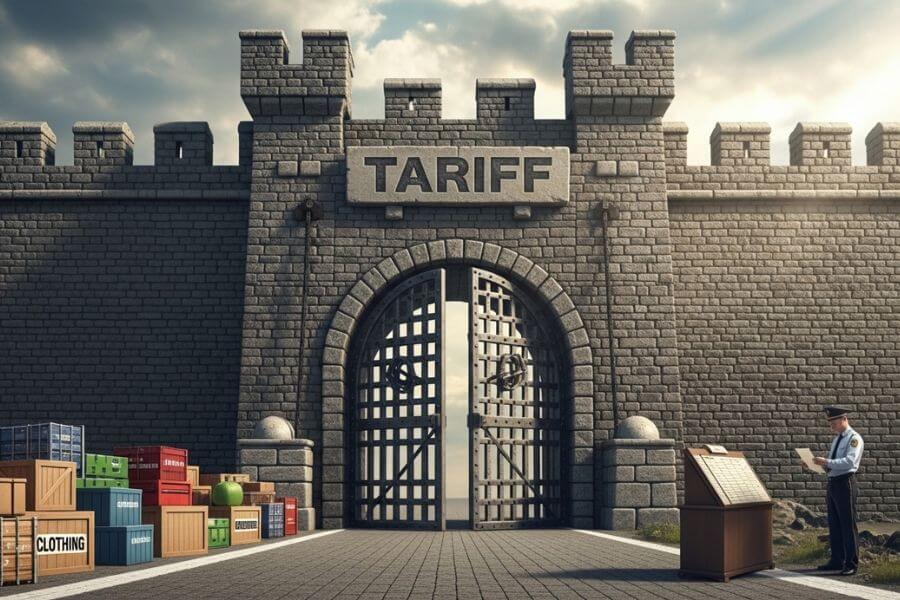
A tariff barrier is a government-imposed tax or duty levied on goods and services crossing international borders. Unlike non-tariff barriers (quotas, regulations, subsidies), tariff barriers are explicitly financial; they raise the cost of imported or, less commonly, exported goods, making domestically produced alternatives relatively more competitive.
The terms tariff and customs duty are often used interchangeably. At their core, tariff barriers serve two purposes: generating government revenue and providing protection for domestic industries.
“A tariff is simply a price placed on international commerce and like all prices, it has consequences that ripple far beyond the point of collection.”
When a country imposes a tariff on, say, imported steel, domestic steel producers face less price competition from foreign rivals. Consumers, however, pay more for steel-based products. This trade-off is at the heart of every debate about tariff policy.
- $2T+ Global tariff revenue collected annually
- 164 WTO member countries are bound by tariff rules
- ~5%Average global tariff rate (down from 22% in 1947)
A Brief History of Tariffs
Tariffs are among the oldest instruments of economic policy. Ancient Egypt, Rome, and medieval city-states all levied duties on goods passing through their territories, primarily to fund government operations and guard key trade routes.
The mercantile era (roughly 1500–1800) saw European powers use tariffs aggressively to accumulate gold and silver by maximizing exports and suppressing imports. Britain’s Corn Laws (1815–1846), which kept grain prices high through stiff import duties, became a landmark controversy. Their repeal marked a decisive shift toward free trade.
In the United States, the Smoot-Hawley Tariff Act of 1930 raised duties on over 20,000 imported goods to historically high levels. Rather than protecting American jobs during the Great Depression, it triggered retaliatory tariffs from trading partners and is widely credited with deepening and prolonging the economic crisis.
The aftermath of World War II ushered in a new era. The General Agreement on Tariffs and Trade (GATT), signed in 1947, began a decades-long process of multilateral tariff reduction, eventually evolving into the World Trade Organization (WTO) in 1995. Average global tariff rates fell from roughly 22% in 1947 to under 5% by the 2010s.
Yet tariffs never disappeared. The trade tensions of the 2018–2026 period between the United States and China, the EU and the UK post-Brexit, and emerging markets asserting industrial policy have firmly placed tariffs back at the center of global politics.
Types of Tariff Barriers
Not all tariffs are created equal. Governments use several distinct structures depending on their policy goals:
- Ad Valorem Tariff: Charged as a percentage of the good’s value. For example, a 10% ad valorem tariff on a $100 item adds $10 at the border. The most common tariff type worldwide.
- Specific Tariff: A fixed dollar amount per unit, e.g., $2 per kilogram of sugar, regardless of price. Predictable but can be regressive, hitting cheaper goods harder proportionally.
- Compound Tariff: A combination of ad valorem and specific components. For example, 5% of the value plus $0.50 per unit. Often used for goods with volatile prices.
- Retaliatory Tariff: Imposed in response to another country’s trade barriers. The US-China trade war of 2018–2020 is a textbook example of each side escalating duties in tit-for-tat rounds.
- Prohibitive Tariff: Set so high that it effectively bans the import. The goal is not revenue but exclusion. Sometimes used to protect infant industries.
- Tariff-Rate Quota (TRQ): A two-tier system: low tariff up to a quantity limit, then a higher tariff for imports above that threshold. Common in agriculture.
- Revenue Tariff: Primarily designed to raise government funds rather than protect domestic producers. Common in developing nations reliant on trade taxes.
- Protective Tariff: Explicitly designed to shield domestic industries from foreign competition, often at the cost of higher consumer prices and trade inefficiency.
How Tariff Barriers Work
The mechanics of a tariff are straightforward. When a foreign firm ships goods into a country, customs authorities assess the applicable duty based on the product’s Harmonized System (HS) code, an internationally standardized classification system covering virtually every traded product.
The importer pays the duty at the border (or from a bonded warehouse). This cost is nearly always passed on to buyers through higher prices. The importing country’s government collects the revenue.
The Economic Mechanics
In economic terms, a tariff shifts the domestic supply-demand equilibrium. Before the tariff, the market price equals the world price. After the tariff:
- Domestic price rises by (approximately) the tariff amount.
- Domestic production expands — previously uncompetitive producers now break even.
- Domestic consumption falls — consumers buy less at the higher price.
- Imports decrease — the gap between domestic supply and demand narrows.
- Government collects revenue on the remaining imports.
Economists measure the efficiency cost of tariffs through the concept of deadweight loss, the value of trade that would have benefited both parties but is now prevented. This loss is a core argument for free trade advocates.
However, if a country is large enough to influence world prices (a “large country”), it can potentially improve its terms of trade by imposing a tariff, effectively extracting part of the economic surplus from foreign exporters. This “optimal tariff” theory is often cited, though it invites retaliation.
Pros and Cons of Tariff Barriers
Tariff barriers are among the most debated tools in economic policy. Here is a balanced overview:
Arguments in Favor
- Protect domestic jobs in targeted industries
- Generate government revenue
- Support infant industries until they mature
- Reduce dependence on foreign suppliers for strategic goods (national security)
- Can be used as leverage in trade negotiations
- Counter unfair trade practices like dumping or foreign subsidies
- Allow developing countries to build industrial capacity
Arguments Against
- Raise prices for consumers and downstream industries
- Reduce economic efficiency and overall welfare
- Trigger retaliatory tariffs, hurting exporters
- Protect inefficient domestic industries from necessary competition
- Can escalate into trade wars with broad economic damage
- Harm developing nations reliant on export-led growth
- Create deadweight loss, value destroyed with no beneficiary
Tariff vs. Non-Tariff Barriers
As multilateral agreements reduced tariff levels through the late 20th century, countries increasingly turned to non-tariff barriers (NTBs) to protect domestic industries through less transparent means. Understanding the distinction is crucial.
Common non-tariff barriers include:
- Import quotas: hard limits on the volume of imports permitted
- Subsidies: government payments to domestic producers that lower their costs
- Regulatory barriers: product standards, labeling requirements, or certifications that foreign goods struggle to meet
- Embargoes: outright bans, usually politically motivated
- Local content requirements: mandating that a portion of a product be made domestically
While tariffs are transparent and generate revenue, NTBs are often opaque and can be harder to challenge under trade rules. The WTO addresses both, but NTBs are notoriously difficult to negotiate away because they are embedded in domestic regulation.
Real-World Examples of Tariff Barriers
The US-China Trade War (2018–Present)
Beginning in 2018, the United States imposed tariffs on hundreds of billions of dollars’ worth of Chinese goods, initially 25% on steel and aluminum, then broad tariffs covering electronics, machinery, and consumer goods. China retaliated with equivalent measures. The conflict reshaped global supply chains, pushed manufacturers to relocate from China to Vietnam, Mexico, and India, and contributed to inflationary pressures worldwide.
The European Union’s Common External Tariff
EU member states operate under a unified customs union, meaning all imports from outside the EU face the same tariff schedule, the Common External Tariff (CET). Agricultural products typically face higher duties (sometimes exceeding 100% for items like sugar), while manufactured goods face lower rates. This makes the EU one of the world’s most significant tariff regimes in terms of economic scope.
India’s Import Substitution Policies
India has historically maintained some of the highest tariff rates among major economies, particularly on electronics, automobiles, and agricultural products. High tariffs on smartphones of over 20% were part of a deliberate strategy to incentivize domestic manufacturing, contributing to the rapid growth of local production by companies like Apple’s contract manufacturers.
Smoot-Hawley and the Great Depression
Perhaps the most cautionary tale in tariff history: the Smoot-Hawley Act (1930) raised US tariffs to an average of 45–50%. Within two years, US imports fell by 66% and exports by 61% as trading partners retaliated. The episode is routinely cited by economists as evidence of the destructive potential of protectionist escalation.
Tariffs and the WTO
The World Trade Organization is the principal multilateral institution governing tariff barriers. Its rules are built on two foundational principles:
- Most-Favored-Nation (MFN): Any trade advantage given to one WTO member must be extended to all WTO members equally.
- National Treatment: Once goods have cleared customs, they must be treated no less favorably than domestically produced goods.
Countries “bind” their tariff rates with the WTO committing not to raise them above a ceiling (the bound rate). The rate actually charged (the applied rate) is often lower. This distinction matters: a country can raise tariffs up to the bound rate without WTO violation.
Disputes are resolved through the WTO’s Dispute Settlement Body (DSB). When one country believes another has violated trade rules, it can file a complaint, triggering a legal process that can authorize retaliatory tariffs as compensation — a system, however, that has faced credibility challenges in recent years.
Economic Impact of Tariff Barriers
The economic effects of tariff barriers depend heavily on context, which sectors are targeted, the size of the imposing country, its trading partners’ responses, and the time horizon considered.
Short-Term Effects
In the short run, tariffs typically protect employment in targeted industries, raise consumer prices, generate government revenue, and may reduce trade deficits in specific product categories. However, they also trigger price increases across supply chains where imported inputs are used.
Long-Term Effects
Over longer time frames, the picture becomes more complex. Protected industries may grow, but productivity growth can stagnate without competitive pressure. Export industries suffer as trading partners retaliate. Currency dynamics shift. Foreign direct investment patterns change.
Research consistently finds that broad tariff increases tend to reduce a country’s overall GDP, though the magnitude depends on the trade openness of the economy and the nature of retaliation.
Distributional Effects
Tariffs redistribute income within economies. Workers in protected industries benefit at least in the short run. But consumers, especially lower-income households who spend more of their income on goods, bear higher prices. Export industries and downstream manufacturers using imported inputs also lose. Understanding who wins and who loses is essential to evaluating tariff policy honestly.
The Future of Tariff Barriers
The arc of global trade policy since 1947 has bent toward liberalization, but that arc is no longer smooth. Several forces are reshaping the tariff landscape heading into the late 2020s:
Geopolitical Fragmentation (“Friendshoring”)
Major economies are increasingly designing trade policy around political alliances rather than purely economic efficiency. The concept of “friendshoring,” concentrating supply chains within trusted partner nations, implies higher tariffs on goods from geopolitical rivals. This represents a fundamental shift from the MFN principle.
Industrial Policy Revival
Subsidies and targeted tariffs are making a comeback as tools of industrial policy. The US Inflation Reduction Act, EU Green Deal, and similar initiatives combine domestic incentives with trade measures to build competitive positions in strategic sectors like semiconductors, electric vehicles, and clean energy.
Carbon Border Adjustments
The EU’s Carbon Border Adjustment Mechanism (CBAM), now in its implementation phase, applies a carbon price to imports from countries without equivalent carbon regulations. While framed as an environmental measure, it functions economically as a tariff. Expect more countries to follow.
Digital Trade Tensions
While traditional tariffs apply to goods, digital services are largely outside existing tariff frameworks. Disputes over data localization, digital services taxes, and platform regulation are creating the functional equivalent of trade barriers in the fastest-growing segment of global commerce.
“The question is no longer whether tariffs will remain relevant — they clearly will. The question is who controls them, and toward what ends.”
Frequently Asked Questions
What is the difference between a tariff and a trade embargo?
A tariff makes imports more expensive but still allows trade to occur. An embargo is an outright ban on trade with a specific country or on specific goods; trade stops entirely. Embargoes are typically used for national security or foreign policy reasons rather than economic ones.
Who actually pays a tariff?
The legal incidence falls on the importer (typically a domestic business), but the economic burden is shared between foreign exporters (who may lower their prices to stay competitive) and domestic consumers and businesses (who pay higher prices). Research on recent US tariffs suggests that American consumers and businesses bore the majority of the cost.
Can tariffs protect jobs?
Tariffs can protect jobs in the specifically targeted industry, often at a significant cost per job saved. However, they tend to reduce employment in export industries (through retaliation) and in downstream industries that use the protected goods as inputs. The net employment effect is typically negative or neutral, and studies suggest the cost per job saved by tariffs is often far higher than alternative policy tools.
What is a “tariff war” or “trade war”?
A trade war occurs when countries escalate tariffs on each other’s goods in retaliatory cycles. Each side raises tariffs in response to the other’s increases. The result is typically higher prices, reduced trade volumes, and economic losses on both sides, a real-world example of the prisoner’s dilemma in international relations.
Are tariffs legal under international law?
Yes, tariffs are generally legal under WTO rules as long as they do not exceed a country’s “bound rates” and comply with non-discrimination principles. There are exceptions for national security, anti-dumping measures, and countervailing duties against foreign subsidies. Disputes are resolved through the WTO’s dispute settlement system.
Conclusion
Tariff barriers are neither purely good nor purely bad; they are policy instruments with real trade-offs. They can protect vulnerable industries, generate revenue, and serve national security objectives. They can also raise prices, distort resource allocation, trigger retaliation, and harm the poorest consumers.
Understanding tariffs requires moving past ideology. Blanket free-trade orthodoxy ignores legitimate arguments for industrial policy and national security. Reflexive protectionism ignores decades of evidence showing that open economies tend to grow faster and deliver greater consumer welfare. The truth, as in most economic questions, lies in context, calibration, and consequences.
As the global economy navigates geopolitical fragmentation, climate transition, and technological disruption, tariff barriers will remain a central and contested feature of international relations. Whether you are a business navigating supply chains, a policymaker weighing trade-offs, or a citizen trying to understand why prices are rising, fluency in tariff dynamics has never been more valuable.