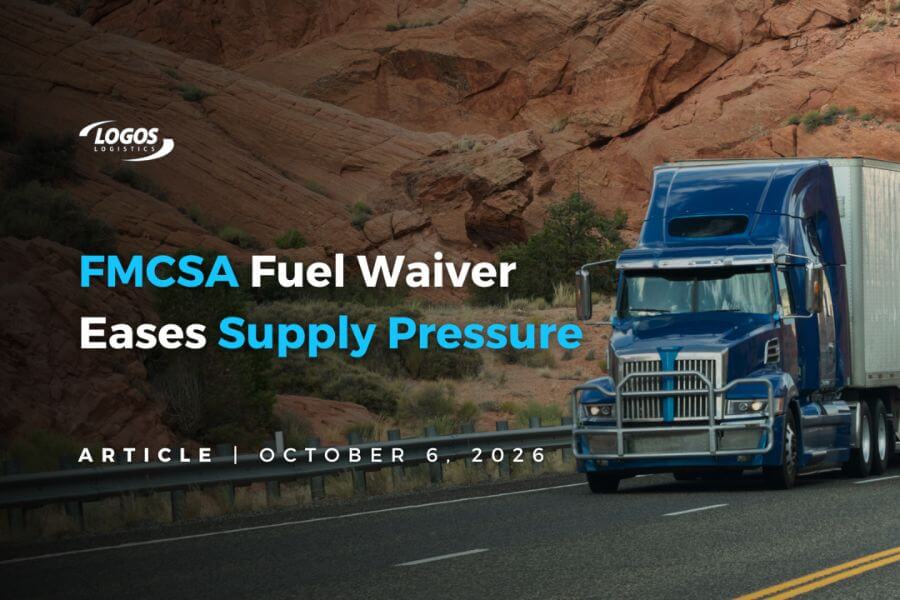
Fuel availability is becoming another pressure point for the U.S. transportation industry, prompting federal regulators to temporarily give gasoline and diesel haulers greater flexibility on the road.
The Federal Motor Carrier Safety Administration (FMCSA) has issued a temporary waiver of certain hours-of-service requirements for motor carriers and drivers transporting gasoline and diesel fuel in interstate commerce. The waiver took effect September 16 and will remain in place through December 16, 2026.
The move comes as global supply disruptions, seasonal transportation demand and agricultural harvesting place additional pressure on U.S. fuel supplies. FMCSA said adequate supplies of gasoline and diesel are critical not only to transportation providers, but also to the movement of goods, agricultural operations and the traveling public.
For an industry already navigating fluctuating transportation costs and rapidly changing supply-chain conditions, the waiver is another reminder of just how closely fuel availability and freight capacity are connected.
More Flexibility — With Strict Limits
The waiver temporarily provides qualified fuel carriers with additional flexibility beyond normal federal hours-of-service rules, but it does not remove the industry’s core safety requirements.
Drivers operating under the waiver cannot drive for more than 16 hours during any 24-hour period. They must also receive at least six consecutive hours of rest in a sleeper berth, or at least eight consecutive off-duty hours if a sleeper berth is unavailable.
Drivers must continue to hold a valid commercial driver’s license and all required endorsements, remain free from applicable out-of-service orders or disqualifications, and carry either a physical or digital copy of the waiver while operating under it.
Driver fatigue protections remain in place as well. If a driver tells a carrier that immediate rest is required, the carrier must allow the driver to reach a safe resting location and provide at least 10 consecutive hours off duty before driving resumes.
When drivers transition from fuel transportation covered by the waiver back into normal operations, a 10-hour break is required once their combined operating time reaches or exceeds 14 hours.
FMCSA also made clear that the waiver does not override other federal and state safety requirements.
Why Diesel Supply Is Under Pressure
The waiver arrives against a difficult global backdrop for diesel production.
The American Petroleum Institute has pointed to a significant reduction in global refining capacity, with Transport Topics reporting that nearly 10% of the world’s fuel-making capacity has been lost and millions of barrels of daily diesel production have effectively been removed from the global market.
U.S. refineries have been working at exceptionally high utilization levels. According to API figures cited by Transport Topics, American refineries produced more diesel in July 2026 than during any previous July, while operating at approximately 97% utilization. The challenge is that running at such high capacity also leaves little room to substantially increase production when demand suddenly rises.
That creates a ripple effect across transportation.
When diesel becomes more expensive or difficult to source, the impact extends beyond fuel distributors. Trucking companies face higher operating expenses, agricultural producers face increased transportation costs and shippers may encounter greater volatility in freight pricing and capacity.
What This Means for Shippers
The FMCSA waiver is specifically designed for companies transporting gasoline and diesel, but the conditions that prompted it matter to practically every business dependent on trucking.
Fuel availability directly influences carrier operating costs. Those costs can influence freight rates, routing decisions, capacity and ultimately the cost of moving products through the supply chain.
It makes transportation planning increasingly important.
Businesses that rely on rigid transportation networks can become vulnerable when fuel markets, capacity or demand change unexpectedly. Working with a logistics provider capable of coordinating multiple parts of the supply chain can provide greater flexibility when market conditions shift.
Building a More Resilient Transportation Network With Logos Logistics
For businesses navigating an unpredictable freight environment, visibility and flexibility can make the difference between reacting to disruption and staying ahead of it.
Logos Logistics provides asset-based trucking and comprehensive third-party logistics services across the United States, supported by strategic locations in Michigan, Ohio, Delaware and California. Its broader service portfolio includes trucking and transportation, 3PL warehousing, freight brokerage, contract logistics and order fulfillment.
That combination allows companies to connect transportation with the other critical parts of their logistics operation rather than managing each stage independently.
Logos also uses transportation management technology supporting shipment scheduling, load configuration, route scheduling, carrier tendering, GPS visibility and web-based reporting — capabilities that become increasingly valuable when capacity and operating conditions are changing quickly.
As diesel supply pressures demonstrate, disruptions don’t have to begin inside your own supply chain to affect your business. Energy markets, government regulations, capacity constraints and seasonal demand can quickly change how freight moves.
The companies best positioned for those changes will be the ones with transportation networks designed to adapt.
Need more flexibility in your transportation and logistics strategy?
From asset-based trucking and freight brokerage to warehousing and contract logistics, Logos Logistics provides integrated solutions designed to keep supply chains moving — even when market conditions change.