If you run a warehouse or manage a supply chain, you already know that where you put things matters enormously. Every extra metre a picker walks, every awkward reach to an ill-placed pallet, every congested aisle, these inefficiencies compound into staggering costs at scale. That is precisely the problem warehouse slotting is designed to solve.
In this comprehensive guide, we’ll cover everything: what slotting is, why it’s one of the highest-ROI investments in warehouse management, the core strategies you can deploy, the technology available today, and the common pitfalls that undermine even well-intentioned slotting programmes.
What is Slotting in Logistics?
Slotting is the systematic process of determining the optimal location for every SKU (stock-keeping unit) within a warehouse or distribution centre. In plain language: it answers the question, “Where should we store each product so we can move it most efficiently?”
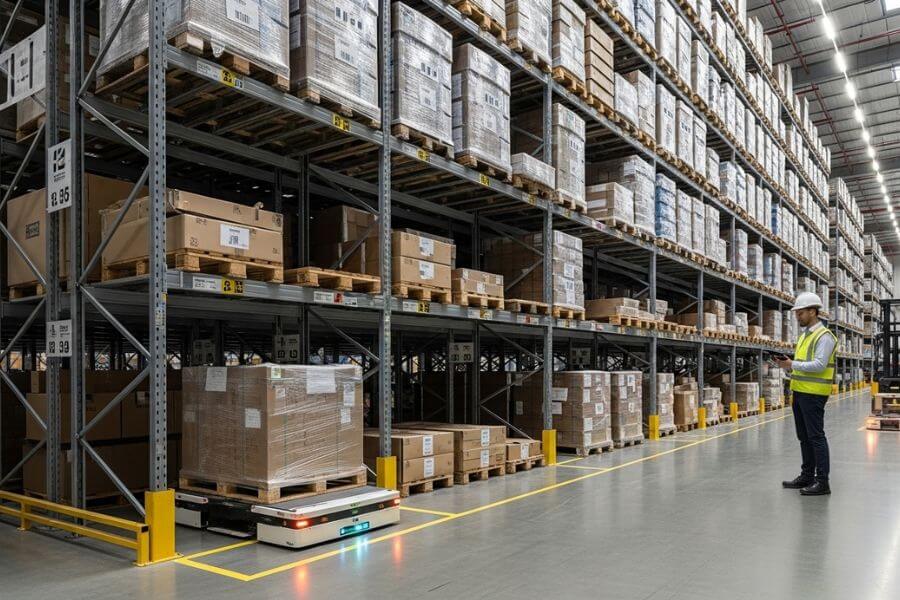
A “slot” is any defined storage location, such as a bin, shelf position, pallet position, rack bay, or floor spot. Slotting assigns each SKU to the slot where it can be retrieved fastest, handled most safely, and replenished most easily, given its particular size, weight, demand velocity, and handling characteristics.
Slotting is not a one-time event. It is an ongoing management discipline that must respond to seasonal shifts, changes in your product catalogue, promotions, supplier changes, and the natural drift in demand patterns over time.
Why Slotting Matters
- 50% of warehouse labour is travel time
- 30% travel reduction possible with optimised slots
- 15–20% throughput increase reported by optimisers
- 2×faster ROI vs. new automation
In most warehouses, picking accounts for 50–60% of total operating costs, and studies consistently show that roughly half of all picking time is spent travelling rather than actually picking. Slotting attacks that wasted travel directly.
The Business Case for Slotting
Well-executed slotting delivers tangible benefits across the entire operation:
- Reduced labour costs: Shorter travel paths mean pickers complete more orders per shift without additional headcount.
- Faster order fulfilment: Products needed together are stored together, dramatically reducing pick cycle times.
- Improved accuracy: Logical, consistent placement reduces the chance of mis-picks and wrong-location errors.
- Lower injury rates: Heavy items placed at ergonomic heights mean fewer musculoskeletal injuries and reduced workers’ compensation claims.
- Better space utilisation: Matching slot sizes to product dimensions eliminates wasted cubic space and avoids the need for costly facility expansion.
- Smoother replenishment: When forward pick locations are sized and positioned correctly, replenishment interruptions during peak periods are minimised.
Key Concepts and Terminology
Before diving into strategies, it helps to have a shared vocabulary:
| Term | Definition |
|---|---|
| SKU | Stock-Keeping Unit, a unique identifier for a distinct product variant (size, colour, pack count, etc.). |
| Slot / Location | Any named, addressable storage position in the warehouse (bin, shelf bay, pallet position). |
| Velocity | How frequently a SKU is picked over a given period; often expressed as picks-per-day or units-per-week. |
| Golden Zone | The ergonomic sweet-spot, shelf heights between knee and shoulder level, where picking is fastest and safest. |
| ABC Analysis | Classifying SKUs into A (high-velocity), B (medium), and C (slow) movers to prioritise premium slot assignment. |
| Slotting Optimisation | The analytical or algorithmic process of computing the best assignment of SKUs to slots to minimise cost or time. |
| Pick Path | The physical route a picker travels through the warehouse to collect all items in a single order or wave. |
| Affinity / Correlated Products | SKUs that are frequently ordered together; placing these near each other reduces multi-line pick travel. |
| Forward Pick Area | A compact, high-density zone reserved for the fastest-moving SKUs to minimise travel during picking. |
| Slotting Coefficient | A scoring metric that combines velocity, pick frequency, and product characteristics to rank SKU placement priority. |
Slotting Strategies
There is no universal best approach. Effective slotting combines several complementary strategies tailored to your operation’s specific constraints.
Velocity-Based (ABC) Slotting
This is the foundation of almost every slotting programme. You classify SKUs by pick frequency and assign the best (shortest-travel) slots to your highest-velocity items.
- A-items (top 20% of SKUs, often ~80% of picks): prime locations closest to pack-out stations, at golden-zone heights, in the most accessible aisles.
- B-items (next ~30% of SKUs): good but not prime locations.
- C-items (slowest ~50% of SKUs): deepest, highest, or least accessible positions where travel cost is irrelevant.
Affinity-Based (Cluster) Slotting
Products frequently ordered together should be slotted near each other, regardless of individual velocity. If 70% of orders that include SKU-A also include SKU-B, placing them adjacent cuts pick travel for that dominant order profile. This requires analysing your order history to identify correlated product pairs and clusters.
Ergonomic Slotting
Physical weight and dimensions determine vertical placement. Heavy items belong at waist height to prevent back strain; light, bulky items go above shoulder height; small, fast items belong in the golden zone. Ergonomic slotting reduces both injuries and the time required per pick.
Family or Category Slotting
Products from the same category or supplier are grouped together. This works well for operations where pickers need to apply category-specific knowledge or where replenishment arrives by category from the dock.
Dynamic Slotting
Unlike static assignment, dynamic slotting continuously re-evaluates and adjusts slot assignments as demand patterns change. Software triggers re-slotting recommendations when a SKU’s velocity shifts significantly, a new product is introduced, or seasonal demand peaks and troughs emerge. Dynamic slotting is particularly valuable in e-commerce and omnichannel environments where demand is volatile.
Zone-Based Slotting
The warehouse is divided into physical zones, each served by dedicated pickers or automated systems. Slotting then optimises placement within each zone to balance workload across zones and minimise inter-zone travel.
💡 Pro Tip
In practice, the most effective programmes combine velocity-based ABC classification as the primary framework with affinity analysis layered on top and ergonomic rules as hard constraints. Treat these as filters applied in sequence rather than competing alternatives.
The Slotting Optimisation Process
Whether you’re optimising a warehouse for the first time or running a periodic re-slotting project, the process follows a consistent sequence.
Step 1: Data Collection
Pull at minimum 90 days of order history (ideally 12 months to capture seasonality). You need per-SKU data on: units picked, order lines, order frequency, product dimensions and weight, current slot dimensions, and any special handling requirements (hazardous, chilled, fragile).
Step 2: SKU Profiling and Classification
Compute the velocity metrics for each SKU and classify them into A/B/C (and optionally D for obsolete). Run an affinity analysis to score the co-occurrence of SKU pairs across orders. Identify any oversize, overweight, or special-condition SKUs that require constrained placement.
Step 3: Slot Profiling
Map every location in the warehouse with its physical attributes: dimensions, maximum weight capacity, height from floor, distance from pack-out station, and zone assignment. This gives you a full picture of the available “supply” of slot types.
Step 4: Matching and Assignment
Match SKU profiles to slot profiles. A-items get the closest slots that physically fit the product. Affinity clusters are placed in proximity to each other within their velocity tier. Heavy items are assigned to ergonomically appropriate heights. The output is a proposed slot assignment for every SKU.
Step 5: Labour Modelling and Validation
Before physically moving thousands of products, model the expected pick-path distances and labour savings. Compare the proposed layout against the current state using historical orders. Most WMS platforms or standalone slotting tools can simulate this. If the savings meet your target, proceed; if not, iterate on the assignment logic.
Step 6: Implementation
Physical moves are typically executed in waves during off-peak hours or planned downtime windows. Communicate clearly with warehouse staff, update your WMS with new location assignments before the move, and validate that barcode or RFID data matches actual placement. Implement a short post-move audit cycle to catch errors.
Step 7: Ongoing Monitoring and Re-Slotting
Track key KPIs: picks per hour, travel distance per order, pick accuracy, before and after the project. Establish a re-slotting cadence: at minimum quarterly reviews for dynamic categories, with automated alerts when a SKU’s velocity changes enough to justify a move.
Technology and Software for Slotting
Manual slotting on spreadsheets is feasible for warehouses with fewer than a few hundred SKUs. Beyond that, dedicated technology becomes essential.
Warehouse Management Systems (WMS)
Most modern WMS platforms include a slotting module or at least the data infrastructure (location master, SKU dimensions, pick history) needed to support slotting analysis. Leading WMS providers offer built-in slotting optimisation with configurable rules and simulation capabilities.
Dedicated Slotting Optimisation Software
Standalone tools offer deeper analytical capabilities: advanced affinity scoring, multi-objective optimisation (minimising travel while balancing workload), constraint modelling for hazardous materials segregation, and simulation of multiple layout scenarios. These tools are typically integrated with the WMS for data exchange.
Warehouse Execution Systems (WES) and Real-Time Slotting
In highly automated environments, WES platforms can make real-time slotting decisions, directing incoming inventory to slots dynamically based on current demand patterns and available capacity, rather than relying on pre-planned static assignments.
AI and Machine Learning
Increasingly, AI-driven demand forecasting is being integrated into slotting workflows. By predicting velocity shifts before they occur, seasonal peaks, promotional lifts, and new product ramp-ups, these systems allow proactive re-slotting rather than reactive adjustment. This is particularly valuable for large e-commerce operations with hundreds of thousands of SKUs.
Slotting Fees in Retail Logistics
It’s worth addressing a distinct but related use of the term “slotting” in retail supply chains. Slotting fees (also called slotting allowances) are payments that manufacturers or suppliers make to retailers in exchange for shelf space, a “slot” on the physical or digital shelf.
What Are Slotting Fees?
When a grocery chain, pharmacy, or large retailer introduces a new product, it typically charges the supplier an upfront fee for the shelf position. These fees compensate the retailer for the risk of carrying a new, unproven SKU: the cost of displacing an existing product, updating planograms, retraining staff, and handling the product if it underperforms and must be discontinued.
How Much Are They?
Slotting fees vary enormously depending on the retailer’s scale, the product category, and the competitive intensity for shelf space. For a national grocery chain, fees for a single product across all stores can range from a few thousand dollars to well over $50,000. Premium end-cap or checkout-lane positions command premium rates.
Are They Legal?
In most jurisdictions, including the United States and the European Union, slotting fees are legal provided they are disclosed and applied consistently. They have attracted regulatory scrutiny as a potential barrier to entry for small suppliers and emerging brands, but they remain standard practice in most retail categories.
Negotiating Slotting Fees
Suppliers can sometimes negotiate or offset slotting fees by demonstrating strong consumer demand data, committing to cooperative advertising, agreeing to buyback arrangements for unsold stock, or offering introductory pricing. Having strong velocity data from existing retailers in other markets is one of the most persuasive levers.
Common Slotting Mistakes to Avoid
Slotting Once and Forgetting
The single most common failure mode. A great initial slotting project delivers gains that erode within 6–12 months as demand patterns change and no one updates the assignments. Build re-slotting into your operational calendar from day one.
Ignoring Product Affinity
Optimising for individual SKU velocity in isolation, without considering which products are commonly ordered together, leaves significant travel-time savings on the table. Affinity analysis typically adds 5–15% more improvement on top of pure velocity slotting.
Over-Engineering the Analysis
Perfect is the enemy of good. An 80% optimal slot assignment that you can implement quickly beats a 95% optimal plan that takes six months to compute and approve. Start with ABC velocity slotting; add sophistication iteratively as you build capability.
Failing to Involve Warehouse Staff
Pickers and supervisors have ground-level knowledge that no data model fully captures, tricky products that are often mis-scanned, aisles with traffic flow problems, and seasonality quirks in specific categories. Their input improves the plan, and their buy-in accelerates implementation.
Neglecting Replenishment in the Design
Slotting that minimises pick travel but creates constant replenishment interruptions (because forward pick slots are too small, or replenishment paths conflict with pick paths) delivers disappointing results. Replenishment flow must be modelled alongside picking.
Using Outdated Data
Running a slotting analysis on an 18-month-old order history misses current velocity trends. Use recent data, at a minimum, the last full quarter, preferably normalised to remove anomalous spikes, and refresh it before each re-slotting cycle.
Best Practices for Slotting Success
- Establish a slotting governance process with a named owner, clear KPIs, and a defined re-slotting cadence at least quarterly for high-velocity SKU tiers.
- Use at least 90 days of order history for velocity classification; 12 months is preferable for operations with seasonal peaks.
- Set clear ergonomic rules as hard constraints before running any optimisation: no items over X kg above shoulder height, no glass items at floor level, etc.
- Model pick paths before moving product, and validate that the new layout actually reduces travel in simulation before committing to physical moves.
- Implement in waves rather than a single “big bang” move, especially in live facilities. This reduces disruption and allows you to validate each wave before proceeding.
- Update your WMS before the physical move, not after. Scanners must point pickers to the new locations from the moment the product lands in its new slot.
- Track KPIs rigorously: picks per labour-hour, travel distance per order line, pick error rate, and replenishment frequency. Measure for at least 30 days post-implementation.
- Integrate seasonal slotting reviews into your planning calendar for predictable peaks (holiday, back-to-school, promotional events) so you can pre-position inventory ahead of the velocity shift.
Conclusion: The Highest-ROI Move in Your Warehouse
Warehouse slotting is one of the most cost-effective interventions available to logistics operators. It requires no new physical infrastructure, no major capital outlay, and yet it directly attacks the largest single cost driver in most picking operations: wasted travel time.
The principles are straightforward: put fast movers close, place heavy items at waist height, keep frequently co-ordered products adjacent, and keep revisiting your assignments as demand evolves. The complexity lies in executing these principles rigorously across thousands of SKUs in a live, constantly changing environment.
Whether you’re running a small regional distribution centre or a multi-site fulfilment network, a structured slotting programme with the right data, the right tools, and a genuine commitment to ongoing maintenance will pay for itself many times over in reduced labour costs, faster throughput, and fewer errors.
Start with your velocity data. Classify your SKUs. Move your A-items first. Then build from there. The warehouse you have tomorrow can move dramatically faster than the one you have today.