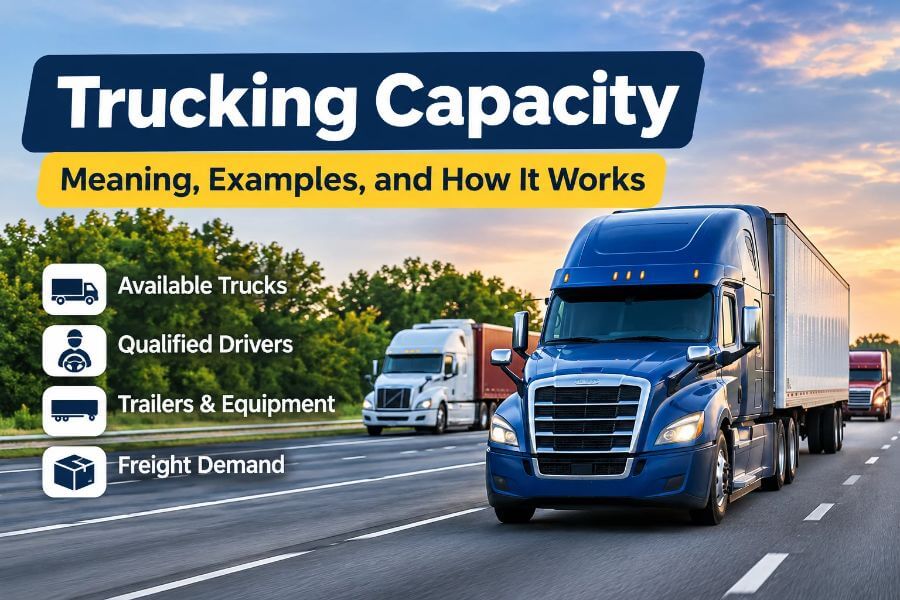
Trucking capacity refers to the transportation resources available to move freight within a specific market, geographic region, or period. It includes available trucks, trailers, qualified drivers, and the operational resources necessary to transport shipments. Trucking capacity plays a significant role in determining freight rates, delivery schedules, carrier availability, and supply chain reliability. When transportation demand exceeds available capacity, shipping costs may increase, and securing trucks can become more difficult. Understanding trucking capacity helps CDL A truck drivers, motor carriers, freight brokers, shippers, and logistics managers make more informed operational and financial decisions.
Trucking Capacity at a Glance
| Category | Description |
|---|---|
| Definition | Available transportation resources for moving freight |
| Primary components | Trucks, trailers, drivers, and equipment |
| Key influencing factors | Freight demand, driver availability, and seasonality |
| Market conditions | Tight, loose, or balanced capacity |
| Financial impact | Freight rates and transportation expenses |
| Operational impact | Delivery reliability and shipment availability |
| Related terminology | Freight demand, spot rate, and tender rejection |
What is Trucking Capacity?
Trucking capacity represents the ability of motor carriers to accommodate freight transportation demand. Although capacity is often associated with the number of trucks available, it also depends on qualified drivers, suitable trailers, equipment conditions, operating schedules, and geographic locations.
A trucking company may own 100 trucks but have only 75 available for new shipments because the remaining vehicles are already assigned, undergoing maintenance, or waiting for drivers.
Capacity is therefore better understood as the transportation resources that can actually be deployed rather than the total number of vehicles a carrier owns.
Trucking capacity can be measured at several levels, including individual fleets, freight lanes, regional markets, equipment categories, and the national freight market.
How Does Trucking Capacity Work?
Trucking capacity operates through the relationship between transportation supply and freight demand. Shippers generate demand by requiring goods to be transported, while motor carriers supply capacity through their drivers, vehicles, and transportation networks.
Several factors determine whether a carrier can accommodate a shipment:
- Truck availability: Whether a suitable tractor is available for dispatch.
- Driver availability: Whether a qualified driver can legally and safely complete the shipment.
- Trailer availability: Whether the carrier has the required equipment.
- Geographic positioning: Whether equipment is located near the pickup location.
- Scheduling flexibility: Whether existing assignments allow additional shipments.
- Freight compatibility: Whether shipment requirements match the carrier’s capabilities.
- Operating costs: Whether the shipment is financially practical for the carrier.
Dispatchers and fleet managers continuously evaluate these factors to allocate transportation resources efficiently.
Real-World Example of Trucking Capacity
Suppose a manufacturing company in Michigan needs to transport 50 truckload shipments to distribution centers throughout the Midwest during a single week. Its primary trucking company has enough available equipment and drivers to handle only 35 shipments.
The manufacturer must secure additional capacity through secondary carriers or a third-party logistics provider.
| Shipment Requirement | Capacity |
|---|---|
| Total freight shipments | 50 |
| Primary carrier capacity | 35 |
| Secondary carrier capacity | 10 |
| Additional spot market capacity | 5 |
| Total secured capacity | 50 |
If the contracted transportation rate is $1,500 per shipment and the five spot market shipments cost $1,900 each, the manufacturer incurs an additional $2,000 in transportation expenses compared with moving all shipments at the original contracted rate.
This illustrative example demonstrates how capacity shortages can increase transportation costs and create operational challenges.
Types of Trucking Capacity
Trucking capacity can be categorized according to equipment, transportation agreements, and operational arrangements. Understanding these categories helps businesses select transportation services that match their shipment requirements.
| Capacity Type | Description |
|---|---|
| Dry van capacity | Available equipment for general freight |
| Refrigerated capacity | Equipment for temperature-controlled shipments |
| Flatbed capacity | Equipment for oversized, industrial, and construction freight |
| Dedicated capacity | Transportation resources assigned to a specific customer |
| Contract capacity | Transportation availability arranged through contractual agreements |
| Spot market capacity | Transportation resources secured on a shipment-by-shipment basis |
| Expedited capacity | Resources available for time-sensitive shipments |
Capacity availability can vary considerably between equipment categories. A market may have abundant dry van capacity while experiencing a shortage of refrigerated trailers.
Tight Trucking Capacity vs. Loose Trucking Capacity
The trucking industry commonly describes market conditions as tight, loose, or balanced. These terms reflect the relationship between available transportation resources and freight demand.
| Factor | Tight Capacity | Loose Capacity |
|---|---|---|
| Truck availability | Limited | Abundant |
| Freight rates | Generally higher | Generally lower |
| Carrier bargaining power | Stronger | Weaker |
| Shipper bargaining power | Weaker | Stronger |
| Tender rejection | Generally higher | Generally lower |
| Freight coverage | More challenging | Easier |
| Carrier competition | Lower | Higher |
Balanced trucking capacity occurs when transportation supply and freight demand are relatively aligned. Under these conditions, shippers can generally secure transportation without significant pricing pressure, while carriers have reasonable opportunities to maintain equipment utilization.
How is Trucking Capacity Measured?
There is no single measurement that captures every aspect of trucking capacity. Industry professionals typically monitor several indicators to evaluate transportation availability and market conditions.
| Metric | What It Measures |
|---|---|
| Load-to-truck ratio | Posted freight loads relative to posted trucks |
| Tender rejection rate | Percentage of freight tenders declined |
| Fleet utilization rate | Percentage of fleet resources actively utilized |
| Truck availability | Number of trucks available for dispatch |
| Spot freight rates | Pricing pressure in the spot market |
| Active carrier count | Number of operating transportation providers |
The load-to-truck ratio is a commonly used indicator of spot market conditions.
Load-to-Truck Ratio = Number of Posted Loads ÷ Number of Posted Trucks
For example, if a freight marketplace has 500 posted loads and 100 posted trucks, the load-to-truck ratio is 5:1.
A rising ratio generally signals increasing competition for available trucks. However, load board activity does not capture every shipment or carrier operating in the trucking industry.
What Factors Affect Trucking Capacity?
Trucking capacity changes continuously in response to economic conditions, seasonal demand, operating expenses, and workforce availability.
- Seasonal demand: Holiday shopping, agricultural harvests, and construction activity can increase transportation requirements.
- Driver availability: Limited numbers of qualified and available drivers can restrict fleet operations.
- Fuel prices: Rising fuel expenses can affect carrier profitability and operating decisions.
- Economic conditions: Manufacturing output, consumer spending, and business activity influence freight volumes.
- Equipment availability: Truck and trailer shortages can restrict fleet expansion.
- Weather conditions: Severe weather can disrupt transportation networks and repositioning activities.
- Carrier profitability: Financial pressures may cause trucking companies to reduce operations or exit the market.
- Detention and delays: Excessive waiting times reduce the number of shipments drivers and trucks can complete.
- Regulatory compliance: Driver scheduling and equipment operations must comply with applicable safety requirements.
These factors can affect national trucking capacity as well as individual freight lanes and regional transportation markets.
Why is Trucking Capacity Important in Logistics?
Trucking capacity directly influences transportation costs, delivery reliability, inventory management, and overall supply chain performance. Businesses that cannot secure sufficient capacity may experience missed delivery appointments, inventory shortages, production interruptions, and increased transportation expenses.
For trucking companies, effective capacity management helps maximize revenue-generating mileage, reduce idle equipment, and improve fleet profitability.
Freight brokers and third-party logistics providers help connect shippers with suitable carriers, particularly when transportation demand exceeds the resources available through existing carrier relationships.
Advantages and Disadvantages of Different Capacity Conditions
Neither tight nor loose trucking capacity benefits every industry participant equally.
| Market Condition | Advantages | Disadvantages |
|---|---|---|
| Tight capacity | Greater carrier negotiating power | Higher shipping costs and limited truck availability |
| Loose capacity | Lower shipping costs and easier freight coverage | Greater carrier competition and revenue pressure |
| Balanced capacity | More predictable transportation planning | Less extreme pricing leverage for either party |
Carriers must balance freight opportunities against operating expenses, while shippers must prioritize both competitive pricing and dependable transportation services.
Trucking Capacity vs. Freight Demand
Trucking capacity and freight demand represent opposite sides of the transportation market.
| Factor | Trucking Capacity | Freight Demand |
|---|---|---|
| Definition | Available transportation resources | Transportation services required |
| Market role | Supply | Demand |
| Primary participants | Motor carriers and drivers | Shippers and businesses |
| Main measurement | Available equipment and transportation resources | Shipments and freight volumes |
| Key influencing factors | Drivers, equipment, and operating conditions | Economic activity and shipping requirements |
Freight rates are influenced by the interaction between these two factors. When freight demand grows faster than trucking capacity, transportation prices may increase. When available capacity grows faster than freight demand, carriers may face greater pricing competition.
Common Misconceptions About Trucking Capacity
Trucking capacity depends only on the number of trucks. Trucks require qualified drivers, appropriate trailers, and sufficient operating time before they can transport freight.
A trucking capacity shortage affects every region equally. Capacity shortages can be concentrated within particular cities, freight lanes, or equipment categories.
Tight capacity guarantees higher driver earnings. Driver earnings depend on compensation agreements, available mileage, freight assignments, and company policies.
Purchasing more trucks immediately increases capacity. Additional equipment provides limited operational value without drivers, maintenance resources, and sufficient freight opportunities.
Loose capacity means there is no freight available. It simply indicates that transportation supply is relatively abundant compared with freight demand.
What CDL A Truck Drivers Should Know About Trucking Capacity
Trucking capacity can influence CDL A job opportunities, dispatch schedules, weekly mileage, and earning potential. During periods of tight capacity, trucking companies may increase recruitment efforts or offer additional freight assignments.
During periods of loose capacity, some carriers may reduce fleet expansion or become more selective about driver recruitment.
When evaluating CDL A trucking jobs, consider freight consistency, dedicated lane availability, compensation structure, dispatch efficiency, equipment reliability, and home time rather than relying solely on general freight market conditions.
A carrier with established customer relationships and consistent contracted freight may provide more predictable assignments even when broader trucking market conditions fluctuate.
How Shippers Can Secure Reliable Trucking Capacity
Businesses can improve transportation reliability by developing long-term carrier relationships and planning freight requirements in advance.
Effective strategies include establishing dedicated transportation arrangements, maintaining backup carrier networks, providing accurate freight forecasts, offering flexible appointment schedules, and minimizing unnecessary loading and unloading delays.
Working with a third-party logistics company can also help shippers access a broader carrier network and secure additional transportation resources during periods of increased demand.
Related Trucking and Logistics Terms
| Term | Definition |
|---|---|
| Freight Demand | The volume of goods requiring transportation services. |
| Tender Rejection | A carrier declining an offered freight shipment. |
| Load-to-Truck Ratio | A measurement comparing posted freight loads with posted trucks. |
| Fleet Utilization | The extent to which available fleet resources are actively used. |
| Spot Rate | A transportation rate negotiated for an individual shipment. |
| Contract Rate | A freight rate established through a transportation agreement. |
| Dedicated Lane | A recurring freight route served under an established transportation arrangement. |
| Deadhead | Operating a truck without revenue-generating freight. |
Frequently Asked Questions
What does tight capacity mean in trucking?
Tight capacity means available transportation resources are relatively limited compared with freight demand. Shippers may experience higher transportation costs and greater difficulty securing suitable carriers.
What causes a trucking capacity shortage?
Capacity shortages can result from increasing freight demand, limited driver availability, equipment shortages, carrier closures, seasonal shipping requirements, and operational disruptions.
How does trucking capacity affect freight rates?
Limited trucking capacity generally creates upward pressure on freight rates because shippers compete for available transportation resources. Excess capacity can create downward pricing pressure as carriers compete for shipments.
Is trucking capacity the same as truck payload capacity?
No. Trucking capacity refers to available transportation resources within a fleet or freight market. Payload capacity refers to the amount of cargo an individual vehicle can safely and legally transport.
How can trucking companies increase capacity without buying more trucks?
Carriers can increase effective capacity by reducing detention time, improving dispatch efficiency, minimizing deadhead mileage, optimizing routes, and reducing equipment downtime. These improvements allow existing transportation resources to handle more freight without necessarily expanding the fleet.
Conclusion
Trucking capacity represents the transportation resources available to accommodate freight demand, including trucks, trailers, qualified drivers, and operational capabilities. Understanding capacity helps carriers improve fleet utilization, shippers manage transportation expenses, and CDL A drivers evaluate freight and employment opportunities. Because capacity fluctuates across markets, seasons, and equipment categories, effective transportation planning requires flexibility and dependable carrier relationships. Professional trucking and third-party logistics services can help businesses maintain reliable freight coverage while responding to changing transportation requirements.