Deconsolidation is an important logistics process that helps businesses move products efficiently from ports, warehouses, and distribution centers to their final destinations. Whether you are importing goods from overseas or managing domestic shipments, understanding deconsolidation can help you improve delivery speed, reduce handling issues, and streamline your supply chain.
In this guide, you will learn what deconsolidation is, how it works, its benefits, challenges, and why it plays a critical role in modern logistics operations.
What Is Deconsolidation in Logistics?
Deconsolidation is the process of breaking down a large shipment into smaller individual shipments after it arrives at a warehouse, distribution center, or logistics facility.
In logistics, multiple shipments from different customers are often combined into one large shipment to reduce transportation costs. Once the shipment reaches its destination, the cargo is separated and sorted according to its final delivery location.
Simply put:
- Consolidation combines multiple shipments into one larger shipment.
- Deconsolidation separates the combined shipment back into individual orders.
This process is commonly used in international shipping, retail distribution, e-commerce fulfillment, and freight transportation.
Quick Summary Table
| Topic | Description |
|---|---|
| Definition | Separating a large shipment into smaller individual shipments |
| Main Purpose | Improve distribution and final delivery efficiency |
| Common Locations | Ports, warehouses, distribution centers, fulfillment centers |
| Transportation Types | Ocean freight, air freight, rail freight, trucking |
| Main Benefit | Faster and more organized delivery |
| Common Users | Importers, retailers, e-commerce businesses, manufacturers |
| Opposite Process | Consolidation |
Why Is Deconsolidation Important?
Without deconsolidation, businesses would struggle to efficiently distribute products to multiple locations.
Imagine a retailer importing a full container of products that need to be delivered to 50 different stores. Instead of sending separate containers to each store, all products arrive together and are later separated through deconsolidation.
This approach helps businesses:
- Reduce transportation costs
- Improve inventory management
- Speed up distribution
- Simplify freight planning
- Improve order accuracy
- Support large-scale operations
How the Deconsolidation Process Works
The deconsolidation process follows several steps.
1. Consolidated Shipment Arrives
A large shipment reaches a port, warehouse, or distribution center.
This shipment may contain:
- Products for multiple customers
- Orders for several retail stores
- Inventory for different warehouses
- E-commerce orders destined for various regions
2. Cargo Is Unloaded
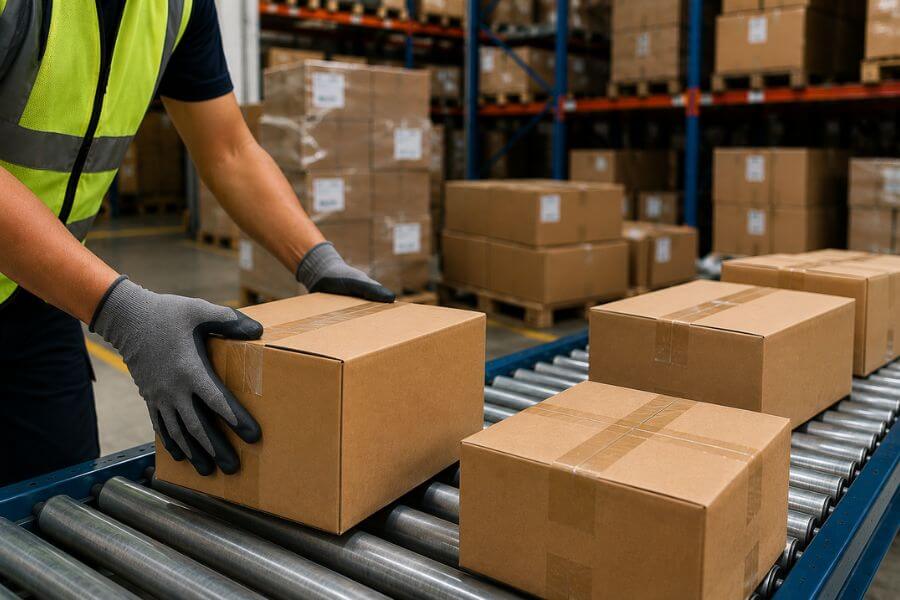
Workers unload the shipment from:
- Shipping containers
- Air cargo units
- Railcars
- Trucks
The cargo is moved into a designated sorting area.
3. Inventory Is Verified
The logistics team checks:
- Product quantities
- Shipping documents
- Labels and barcodes
- Order information
- Packaging condition
This helps identify discrepancies before distribution begins.
4. Products Are Sorted
Items are grouped according to:
- Customer orders
- Delivery routes
- Geographic regions
- Distribution centers
- Retail locations
Warehouse management systems often assist with this process.
5. Individual Shipments Are Prepared
Each shipment is packaged, labeled, and prepared for outbound transportation.
This may involve:
- Pallet building
- Repackaging
- Relabeling
- Quality inspections
6. Final Distribution
The separated shipments are loaded onto outbound trucks and delivered to their final destinations.
Common Examples of Deconsolidation
Retail Distribution
A retailer imports one container containing products for dozens of stores.
After arrival:
- Products are separated by store location
- Orders are prepared individually
- Shipments are sent to each store
E-commerce Fulfillment
An online seller receives bulk inventory from a manufacturer.
The inventory is:
- Deconsolidated at a fulfillment center
- Stored in warehouse locations
- Used to fulfill individual customer orders
Automotive Logistics
Automotive suppliers often ship parts in large quantities.
At a logistics center:
- Parts are sorted by manufacturer
- Orders are separated by production facility
- Shipments are sent according to manufacturing schedules
Grocery and Food Distribution
Food distributors receive bulk shipments and separate products for:
- Supermarkets
- Convenience stores
- Restaurants
- Wholesale customers
Benefits of Deconsolidation
Deconsolidation offers several advantages across the supply chain.
- Lower Transportation Costs: Combining freight during transportation and separating it later is usually more cost-effective than shipping everything individually.
- Faster Deliveries: Products can be quickly routed to their final destinations after sorting.
- Better Inventory Control: Businesses gain improved visibility over inventory as shipments are sorted and tracked.
- Increased Distribution Efficiency: Distribution centers can process large volumes of goods more efficiently.
- Improved Customer Satisfaction: Accurate sorting and faster deliveries help improve customer experiences.
- Better Use of Warehouse Space: Products move through facilities more efficiently, reducing unnecessary storage time.
Industries That Commonly Use Deconsolidation
Many industries depend on deconsolidation to manage large shipment volumes.
- Retail: Retail chains frequently distribute products to multiple store locations.
- E-commerce: Online retailers rely on deconsolidation to process inventory and fulfill customer orders.
- Manufacturing: Manufacturers use deconsolidation to distribute raw materials and finished goods.
- Automotive: Automotive supply chains often require precise sorting and delivery of parts.
- Healthcare: Medical suppliers distribute products to hospitals, clinics, and pharmacies.
- Consumer Goods: Consumer product companies use deconsolidation to support nationwide distribution networks.
Deconsolidation vs Consolidation
Many people confuse these two logistics terms.
| Consolidation | Deconsolidation |
|---|---|
| Combines multiple shipments | Separates large shipments |
| Happens before transportation | Happens after transportation |
| Reduces freight costs | Improves distribution efficiency |
| Creates larger shipments | Creates smaller shipments |
| Used at shipping origin | Used near destination |
Both processes often work together as part of the same supply chain strategy.
Challenges of Deconsolidation
Although beneficial, deconsolidation can present challenges.
- Labor Requirements: Sorting and handling products requires skilled warehouse staff.
- Warehouse Capacity: Facilities need adequate space to receive and sort shipments.
- Inventory Accuracy: Incorrect sorting can lead to shipping errors and delays.
- Technology Dependence: Many operations rely heavily on warehouse management systems and barcode scanning technology.
- Time Constraints: High shipment volumes can create bottlenecks during peak seasons.
Technology Used in Deconsolidation
Modern logistics facilities use technology to improve accuracy and efficiency.
Common tools include:
- Warehouse Management Systems (WMS)
- Barcode scanners
- RFID tracking systems
- Automated sorting equipment
- Transportation Management Systems (TMS)
- Inventory management software
These tools help reduce errors and improve shipment visibility.
Best Practices for Successful Deconsolidation
To maximize efficiency, businesses should follow proven best practices.
Use Accurate Labeling
Clear labels reduce sorting mistakes and speed up processing.
Implement Warehouse Technology
Automation and inventory software improve accuracy and productivity.
Train Employees Regularly
Well-trained staff can process shipments more efficiently.
Optimize Warehouse Layout
Efficient warehouse design reduces travel time and handling costs.
Monitor Performance Metrics
Track key metrics such as:
- Order accuracy
- Processing time
- Labor productivity
- On-time delivery rates
The Future of Deconsolidation
As global supply chains become more complex, deconsolidation will continue to grow in importance.
Several trends are shaping the future:
- Increased warehouse automation
- Greater use of robotics
- AI-powered inventory management
- Real-time shipment visibility
- Faster e-commerce fulfillment requirements
Businesses that invest in efficient deconsolidation processes will be better positioned to meet customer expectations and manage growing shipment volumes.
Conclusion
Deconsolidation is a vital logistics process that separates large shipments into smaller, destination-specific deliveries. It helps businesses reduce transportation costs, improve distribution efficiency, increase inventory visibility, and support faster deliveries.
Whether you operate in retail, manufacturing, automotive, healthcare, or e-commerce, understanding deconsolidation can help you build a more efficient and scalable supply chain. As logistics networks continue to evolve, effective deconsolidation strategies will remain a key component of successful distribution operations.
Frequently Asked Questions
Can deconsolidation occur multiple times during a shipment’s journey?
Yes. Large shipments may be deconsolidated at regional distribution centers and then further separated at local facilities before reaching their final destinations.
Does deconsolidation increase shipping costs?
While deconsolidation adds handling costs, it often lowers overall logistics expenses because freight is transported more efficiently in larger consolidated loads.
Is deconsolidation only used for international shipping?
No. Deconsolidation is widely used in both domestic and international logistics networks whenever shipments need to be distributed to multiple destinations.
How long does the deconsolidation process typically take?
Processing time depends on shipment size, warehouse capacity, staffing levels, and technology. It can range from a few hours to several days.
What is a deconsolidation warehouse?
A deconsolidation warehouse is a facility where large inbound shipments are received, sorted, separated, and prepared for outbound distribution to individual customers or locations.