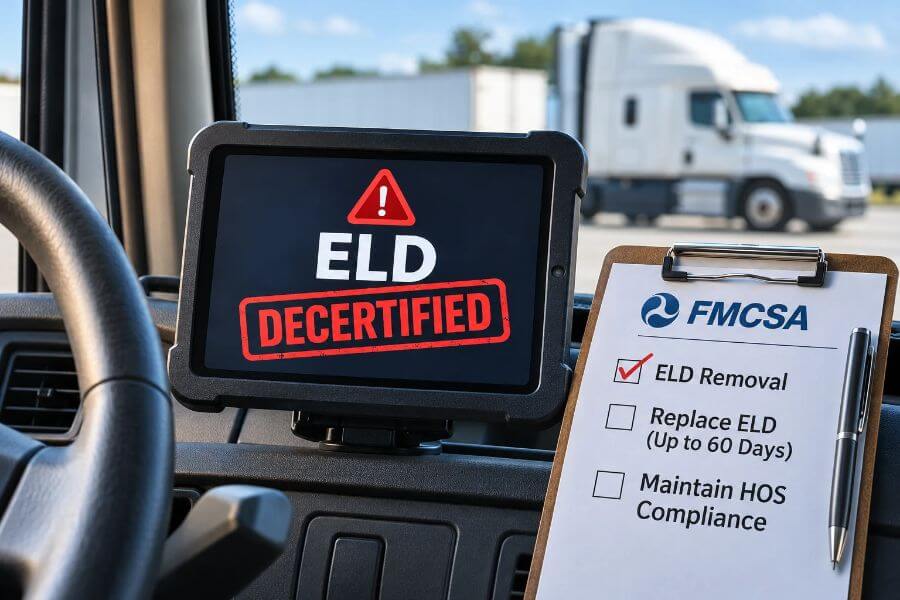
ELD decertification refers to the removal of an electronic logging device (ELD) from the Federal Motor Carrier Safety Administration’s (FMCSA) list of registered devices because it no longer meets applicable requirements or its registration has been withdrawn. When an ELD is removed from this list, affected motor carriers and CDL A truck drivers must take appropriate action to maintain Hours of Service (HOS) compliance. Continuing to use a revoked device beyond an authorized transition period can result in compliance violations. Understanding ELD decertification helps drivers and fleet managers avoid operational disruptions, maintain accurate driving records, and prepare for roadside inspections.
ELD Decertification at a Glance
| Category | Description |
|---|---|
| Definition | Removal of an ELD from the registered devices list |
| Regulatory authority | Federal Motor Carrier Safety Administration (FMCSA) |
| Applicable regulation | 49 CFR Part 395 |
| Common cause | Failure to meet federal ELD requirements |
| Replacement period | Typically up to 60 days, subject to FMCSA instructions |
| Noncompliance consequences | Violations and potential out-of-service orders |
| Affected parties | Truck drivers, motor carriers, and ELD providers |
What is ELD Decertification?
ELD decertification occurs when an electronic logging device loses its registered status and can no longer be used as a compliant ELD under federal regulations. The FMCSA maintains a public registry of devices that manufacturers and technology providers have self-certified as meeting applicable technical standards.
Unlike a traditional government certification program, ELD providers are responsible for testing and certifying their own devices before registering them with FMCSA. Registration does not necessarily mean that the agency has independently tested and approved every device.
If FMCSA determines that a device fails to meet federal requirements, it can initiate a removal process. Once removed, the device may appear on the agency’s Revoked Devices list.
How Does ELD Decertification Work?
The decertification process generally begins when FMCSA identifies deficiencies involving a registered electronic logging device. These deficiencies may relate to technical performance, data integrity, or failure to satisfy mandatory specifications.
The process generally involves the following steps:
- Identification of deficiencies: FMCSA identifies potential problems with a registered ELD.
- Notification: The ELD provider receives notice regarding the identified deficiencies and proposed removal.
- Provider response: The provider receives an opportunity to respond or address the problems under the applicable regulatory process.
- Regulatory determination: FMCSA evaluates whether the device satisfies federal requirements.
- Device removal: Noncompliant devices may be removed from the registered devices list.
- Industry notification: FMCSA communicates the removal and applicable instructions to motor carriers and drivers.
- Device replacement: Affected carriers transition to compliant electronic logging devices.
An ELD provider may regain registered status by correcting identified deficiencies and completing the applicable reinstatement process.
Why Does FMCSA Decertify Electronic Logging Devices?
Electronic logging devices must satisfy technical requirements established under 49 CFR Part 395, Subpart B, Appendix A. These requirements are designed to support accurate recording, retention, and inspection of driver duty status information.
Potential reasons for ELD decertification include:
- Inaccurate driving records: Failure to properly capture required driving activity.
- Data integrity problems: Inadequate protection of electronic records against unauthorized changes.
- Engine synchronization issues: Failure to obtain required information from the vehicle.
- Data transfer failures: Inability to provide required records during roadside inspections.
- Technical deficiencies: Failure to satisfy mandatory ELD functionality requirements.
- Unresolved compliance issues: Failure by the provider to correct identified problems.
- Improper certification: Registration of a device that does not satisfy applicable standards.
The specific reason for removal varies depending on the device and the findings of FMCSA.
What is the 60-Day ELD Replacement Period?
FMCSA commonly provides motor carriers with up to 60 days to replace a revoked electronic logging device with a compliant alternative. However, this replacement period does not mean carriers should continue using the revoked device as their primary logging system.
FMCSA removal announcements generally instruct affected carriers to discontinue reliance on revoked equipment and temporarily maintain required duty status records using paper logs or logging software.
| Period | Required Action |
|---|---|
| Removal announcement | Identify affected devices and drivers |
| Transition period | Maintain required HOS records using permitted alternatives |
| Before replacement deadline | Install and implement a registered ELD |
| After replacement deadline | Use a compliant ELD unless an applicable exemption exists |
Motor carriers should always follow the replacement deadline and enforcement instructions specified in the individual FMCSA announcement.
Real-World Example of ELD Decertification
Suppose a Michigan trucking company operates a fleet of 50 commercial trucks equipped with electronic logging devices from the same technology provider. FMCSA subsequently removes that ELD model from its registered devices list because it fails to meet federal technical requirements.
The carrier must implement a replacement strategy while continuing to maintain compliant Hours of Service records.
| Replacement Expense | Illustrative Cost |
|---|---|
| Replacement devices | $12,500 |
| Installation expenses | $3,750 |
| Driver training | $2,000 |
| Administrative transition | $1,500 |
| Total estimated cost | $19,750 |
In this hypothetical example, replacing the entire fleet’s electronic logging devices costs approximately $395 per truck, excluding ongoing subscription fees.
The company must also preserve historical driver records, train employees, configure replacement equipment, and minimize disruptions to freight operations. Actual replacement costs depend on the provider, equipment requirements, and service agreement.
Why is ELD Decertification Important in Trucking?
ELD decertification affects several aspects of commercial transportation, including regulatory compliance, driver safety, operational efficiency, and financial performance.
Accurate electronic logging helps carriers manage driver schedules and monitor compliance with applicable Hours of Service requirements. When a device becomes noncompliant, the reliability of these processes may be affected.
Carriers that fail to respond appropriately to decertification announcements may encounter roadside inspection violations, delivery interruptions, additional administrative expenses, and out-of-service orders.
Maintaining compliant logging equipment is therefore an essential component of effective fleet safety management.
ELD Decertification vs. ELD Malfunction
ELD decertification and ELD malfunction are different compliance situations that require different responses.
| Factor | ELD Decertification | ELD Malfunction |
|---|---|---|
| Definition | Removal of an ELD from the registered list | Failure of an individual ELD to function properly |
| Primary cause | Registration or compliance deficiencies | Hardware, software, or connectivity problems |
| Scope | Affected device model or version | Individual device or vehicle |
| Corrective action | Transition to a registered ELD | Repair, replacement, or correction |
| Typical timeframe | Up to 60 days under removal notices | Eight days for repair or replacement, unless extended |
| Regulatory status | Device registration has been removed | Device may remain registered |
A malfunction does not automatically mean an ELD has been decertified. Similarly, a revoked device may appear to function normally while no longer satisfying registration requirements.
Under 49 CFR 395.34, ELD malfunctions are subject to separate reporting, recordkeeping, and corrective action requirements.
What Happens if You Continue Using a Decertified ELD?
Continuing to use a revoked ELD after its applicable replacement deadline can result in serious regulatory and operational consequences. When an ELD is required, enforcement personnel may consider a driver using a revoked device to be operating without a compliant electronic logging device.
Potential consequences include:
- Hours of Service violations: Citations related to required duty status records.
- Out-of-service orders: Drivers may be prohibited from continuing commercial vehicle operations under applicable enforcement criteria.
- Financial losses: Delayed shipments, additional expenses, and potential penalties.
- Compliance concerns: Inspection violations may affect a carrier’s safety compliance history.
- Customer dissatisfaction: Transportation disruptions may result in missed delivery appointments.
- Administrative expenses: Additional resources may be required to resolve compliance problems.
FMCSA removal announcements specifically address enforcement under 49 CFR 395.8(a)(1) and applicable Commercial Vehicle Safety Alliance (CVSA) out-of-service criteria.
How to Check Whether an ELD Has Been Decertified
Motor carriers and truck drivers can verify the registration status of an electronic logging device through FMCSA’s official ELD registry.
The verification process is straightforward:
- Visit the FMCSA electronic logging device website.
- Review the Registered Devices list.
- Review the Revoked Devices list.
- Identify your ELD provider and device name.
- Compare the model number and ELD identifier.
- Review applicable removal announcements and replacement deadlines.
- Contact your safety department or technology provider if clarification is necessary.
Checking the exact model and ELD identifier is important because a provider may offer multiple devices with different registration statuses.
Motor carriers should periodically review the registry rather than relying exclusively on information provided when purchasing their equipment.
Common Misconceptions About ELD Decertification
FMCSA independently certifies every registered ELD. ELD providers generally self-certify their products as meeting federal technical requirements before registering them with the agency.
A decertified ELD automatically stops working. A revoked device may continue recording information even though it no longer qualifies as a registered ELD.
Drivers can permanently switch to paper logs after decertification. Temporary alternatives may be permitted during a transition period, but drivers subject to the ELD mandate must return to compliant electronic logging unless an exemption applies.
ELD decertification is permanent. A provider may regain registered status after resolving the deficiencies identified by FMCSA.
Decertification cancels a driver’s CDL. Device removal affects the electronic logging system rather than the driver’s commercial driver’s license. However, failure to maintain compliance can result in enforcement consequences.
What CDL A Truck Drivers Should Know About ELD Decertification
As a CDL A truck driver, you should understand how to maintain accurate Hours of Service records when your assigned electronic logging device becomes decertified.
Although motor carriers are responsible for providing compliant logging equipment when required, drivers also have responsibilities relating to accurate recordkeeping and regulatory compliance.
If your ELD has been revoked, you should:
- Notify your dispatcher or safety department.
- Confirm the device’s registration status.
- Follow the applicable FMCSA transition instructions.
- Maintain accurate records of duty status.
- Ensure previous driving records remain accessible.
- Learn how to operate the replacement ELD.
- Understand how to present required records during roadside inspections.
- Continue complying with applicable Hours of Service limitations.
When evaluating CDL A trucking jobs, consider whether the employer maintains reliable equipment, provides ELD training, and offers adequate compliance support.
What Motor Carriers Should Know About ELD Decertification
Motor carriers should establish procedures for monitoring ELD registration status and responding to device removal announcements. Proactive compliance management can reduce the financial and operational impact of unexpected equipment replacements.
Important considerations include selecting reliable technology providers, maintaining secure backups of driver records, reviewing provider service agreements, and developing contingency procedures for logging disruptions.
Carriers required to retain records of duty status must generally maintain those records and applicable supporting documents for six months. Changing ELD providers does not eliminate existing record retention responsibilities.
Fleet managers should also verify replacement device registration, test data transfer capabilities, configure driver accounts, and provide appropriate training before deployment.
Related Trucking and Logistics Terms
| Term | Definition |
|---|---|
| Electronic Logging Device (ELD) | A system that electronically records required commercial driver duty status information. |
| Hours of Service (HOS) | Regulations governing commercial driver driving and on-duty time. |
| Record of Duty Status (RODS) | A record documenting a driver’s duty status throughout a reporting period. |
| ELD Malfunction | A failure that prevents an electronic logging device from functioning as required. |
| Out of Service (OOS) | An enforcement status that prohibits specified commercial vehicle or driver operations until applicable conditions are satisfied. |
| Roadside Inspection | An examination of commercial vehicle and driver safety compliance. |
| FMCSA | The federal agency responsible for regulating commercial motor vehicle safety. |
| ELD Mandate | Federal requirements governing electronic logging device use by applicable commercial drivers and carriers. |
Frequently Asked Questions
How long do trucking companies have to replace a decertified ELD?
FMCSA commonly allows motor carriers up to 60 days to replace revoked electronic logging devices. However, carriers must follow the specific deadline and recordkeeping instructions established in the relevant removal announcement.
Can a truck driver use paper logs if an ELD is decertified?
Yes, paper logs or permitted logging software may be used temporarily under applicable FMCSA transition instructions. This temporary arrangement does not establish a permanent exemption from the ELD mandate.
Can a decertified ELD be reinstated?
Yes, FMCSA may restore a device to the registered devices list after its provider corrects identified deficiencies. Carriers should confirm official reinstatement before relying on the device for compliance.
Can you be placed out of service for using a decertified ELD?
Yes, drivers who are required to use an ELD may be placed out of service for continuing to use revoked equipment after the applicable enforcement deadline. The specific enforcement action depends on the circumstances and applicable out-of-service criteria.
Who pays for replacing a decertified ELD?
Replacement costs depend on the driver’s employment arrangement, equipment ownership, and technology provider agreement. Motor carriers generally arrange replacement equipment for company-owned trucks, while owner-operators may be responsible for their own devices, depending on contractual arrangements.
Conclusion
ELD decertification occurs when an electronic logging device loses its registered status and no longer qualifies for compliant use under applicable federal requirements. Motor carriers and CDL A truck drivers must respond promptly by maintaining accurate Hours of Service records and transitioning to registered replacement equipment within the applicable deadline. Regularly monitoring FMCSA announcements, preserving historical records, and investing in dependable fleet technology can help prevent compliance violations, minimize transportation disruptions, and maintain safe commercial trucking operations.